
Leveraging AI & predictive analytics to move from reactive treatment to predictive treatment

- November 27, 2025
- 10:01 am
- Laxman Gore
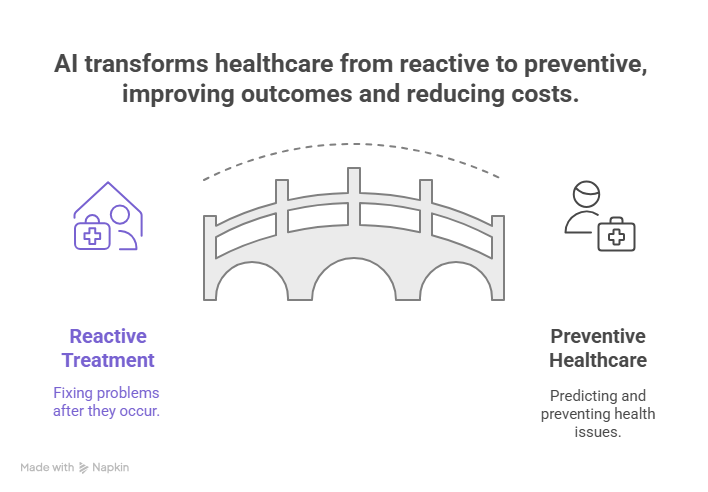
Healthcare has always been about fixing what’s broken. A patient shows symptoms, visits a doctor, gets diagnosed, and receives treatment. But what if we could predict health issues before they become serious problems? Thanks to artificial intelligence and predictive analytics, this shift from reactive treatment to preventive healthcare is not just possible anymore, it’s already happening.
The healthcare industry is sitting on mountains of data from electronic health records, wearable devices, genetic testing, and medical imaging. The challenge has been making sense of all this information in real time. AI and predictive analytics are changing that equation, helping healthcare providers identify risks early, personalize care plans, and ultimately save lives while reducing costs.
Why Preventive Healthcare Matters Now More Than Ever
The traditional healthcare model is unsustainable. Chronic diseases like diabetes, heart disease, and cancer account for the majority of healthcare spending, yet many of these conditions are preventable or manageable if caught early. Hospitals are overcrowded, healthcare costs continue to rise, and physician burnout is at an all-time high.
Preventive healthcare flips this model on its head. Instead of waiting for patients to get sick, healthcare providers can use data to predict who is at risk and intervene before conditions worsen. This approach not only improves patient outcomes but also reduces the financial burden on healthcare systems. Early intervention is almost always cheaper and more effective than treating advanced disease.
The timing couldn’t be better. With the explosion of health data from smartwatches, fitness trackers, and remote monitoring devices, we now have unprecedented visibility into patient health outside clinical settings. AI can process this continuous stream of information to spot patterns that human clinicians might miss.
How AI and Predictive Analytics Work in Healthcare
At its core, predictive analytics uses historical data to forecast future events. In healthcare, this means analyzing patient records, lab results, imaging data, and even social determinants of health to predict disease risk. Machine learning algorithms can identify subtle patterns across millions of data points, patterns that would be impossible for humans to detect manually.
For example, AI systems can analyze a patient’s medical history, lifestyle factors, genetic markers, and even environmental data to calculate their risk of developing conditions like Type 2 diabetes or cardiovascular disease. These risk scores help doctors prioritize interventions for high-risk patients, from lifestyle counseling to preventive medications.
Natural language processing, a branch of AI, can scan through years of unstructured clinical notes to extract insights about a patient’s health trajectory. This technology can flag concerning trends, such as gradual weight gain or recurring symptoms that might indicate an emerging condition. The system essentially acts as a tireless assistant, continuously monitoring for warning signs.
Computer vision powered by AI is revolutionizing medical imaging. Algorithms can detect early signs of cancer, retinal disease, or bone fractures with accuracy that matches or exceeds human radiologists. What makes this truly preventive is the speed and consistency. AI can screen thousands of images quickly, ensuring that subtle early-stage abnormalities don’t slip through the cracks.
Real-World Applications Transforming Patient Care
Healthcare organizations around the world are already implementing AI-driven preventive care programs with measurable results. Hospitals are using predictive models to identify patients at high risk for hospital readmission, allowing care teams to provide additional support and follow-up care that keeps people healthy at home.
Chronic disease management has been transformed by continuous monitoring and AI analytics. Patients with conditions like congestive heart failure wear devices that track vital signs in real time. When the AI detects worrying trends, such as fluid retention or irregular heart rhythms, it alerts healthcare providers who can adjust treatment before the patient ends up in the emergency room.
Cancer screening has become more targeted and effective. Instead of blanket screening protocols, AI can help determine which patients need more frequent or intensive screening based on their individual risk profiles. This personalized approach catches cancers earlier while reducing unnecessary procedures for low-risk individuals.
Mental health is another frontier where predictive analytics is making a difference. By analyzing patterns in patient communication, social media activity, and self-reported mood data, AI systems can identify individuals at risk for mental health crises and connect them with appropriate resources before situations become critical.
Overcoming Challenges and Building Trust
Despite the enormous potential, the path to AI-powered preventive healthcare isn’t without obstacles. Data privacy and security are paramount concerns. Patients need assurance that their sensitive health information is protected, and healthcare organizations must comply with strict regulations while still leveraging data for insights.
Algorithm bias is another critical issue. AI systems are only as good as the data they’re trained on. If training data doesn’t represent diverse populations, the resulting models may not work equally well for everyone. Healthcare organizations must prioritize developing and validating AI tools across different demographic groups to ensure equitable care.
Clinical integration presents practical challenges too. Healthcare providers are already stretched thin, and introducing new technologies requires training, workflow changes, and demonstrated value. The most successful implementations focus on augmenting rather than replacing human judgment, positioning AI as a tool that makes clinicians more effective rather than obsolete.
Building trust takes time. Patients and providers alike need to understand how AI recommendations are generated and feel confident in their reliability. Transparency in AI decision-making, combined with clear communication about the technology’s capabilities and limitations, is essential for widespread adoption
How Salesforce Health Cloud Enables Preventive Care at Scale
Moving to preventive healthcare requires more than just AI algorithms. It demands a unified platform that can integrate data from multiple sources, engage patients effectively, and coordinate care across teams. This is where Salesforce Health Cloud comes into play.
Salesforce Health Cloud provides a 360-degree view of each patient by bringing together data from electronic health records, wearables, patient portals, and other sources into a single platform. This comprehensive patient profile is exactly what AI and predictive analytics need to generate accurate risk assessments and personalized care recommendations.
The platform’s care coordination capabilities ensure that predictive insights translate into action. When AI identifies a high-risk patient, Health Cloud can automatically trigger care pathways, schedule follow-up appointments, and assign tasks to appropriate team members. This orchestration is critical because prevention only works when insights lead to timely intervention.
Patient engagement features in Health Cloud help healthcare organizations shift from episodic care to continuous relationships. Through personalized messaging, educational content, and remote monitoring integrations, providers can keep patients engaged in their health between visits. This ongoing connection is fundamental to preventive care, where early warning signs often appear outside clinical settings.
Einstein AI, Salesforce’s artificial intelligence layer, can be applied within Health Cloud to predict appointment no-shows, identify patients likely to skip medications, and recommend the most effective communication channels for each individual. These capabilities help healthcare teams work more efficiently while delivering more personalized preventive care.
The Future is Preventive
The transformation from reactive treatment to preventive healthcare represents one of the most significant shifts in medicine’s history. AI and predictive analytics are the engines driving this change, turning vast amounts of health data into actionable insights that keep people healthier for longer.
The benefits extend beyond individual patients. Healthcare systems can operate more efficiently, directing resources to interventions that prevent expensive emergency care and hospitalizations. Employers see healthier, more productive workforces. Society as a whole gains from increased quality of life and reduced healthcare expenditures.
Success in this new paradigm requires the right technology foundation. Platforms that unify data, enable AI-powered insights, and facilitate coordinated care delivery will separate healthcare leaders from laggards. The organizations embracing these tools today are building the preventive healthcare systems of tomorrow.
The question is no longer whether healthcare will become more preventive, but how quickly organizations can adapt to make it happen. For healthcare leaders, technology decision-makers, and anyone invested in better health outcomes, the time to act is now. The tools exist, the data is available, and the potential to transform lives is enormous.
Latest Post
The AI Impact on Salesforce:…
When AI Meets the World’s #1 CRM Salesforce built its reputation on one core idea:…
How Generative AI Is Reshaping…
The CRM You Knew No Longer Exists Customer Relationship Management was built on a simple…
How AI is Transforming Salesforce…
We Are Living the AI Revolution — Inside the CRM There was a time when…