
The digital lending landscape in India just got a major overhaul. With RBI issuing the Digital Lending Directions 2025 on May 8, 2025, every digital lender now faces a critical challenge: how do you scale credit operations while staying fully compliant with the most comprehensive regulatory framework India has ever seen?
The answer lies not in choosing between growth and compliance, but in redesigning your entire product and platform architecture to make compliance a competitive advantage. The companies that master this integration will dominate the next decade of digital lending in India.
The New Reality: Compliance as Core Architecture
The 2025 Directions are not just regulatory updates—they represent a fundamental shift in how digital lending must operate. The Chief Compliance Officer (CCO) of each Regulated Entity is now accountable for certifying that all digital lending workflows comply with DLG 2025, making compliance a board-level responsibility that cannot be treated as an afterthought.
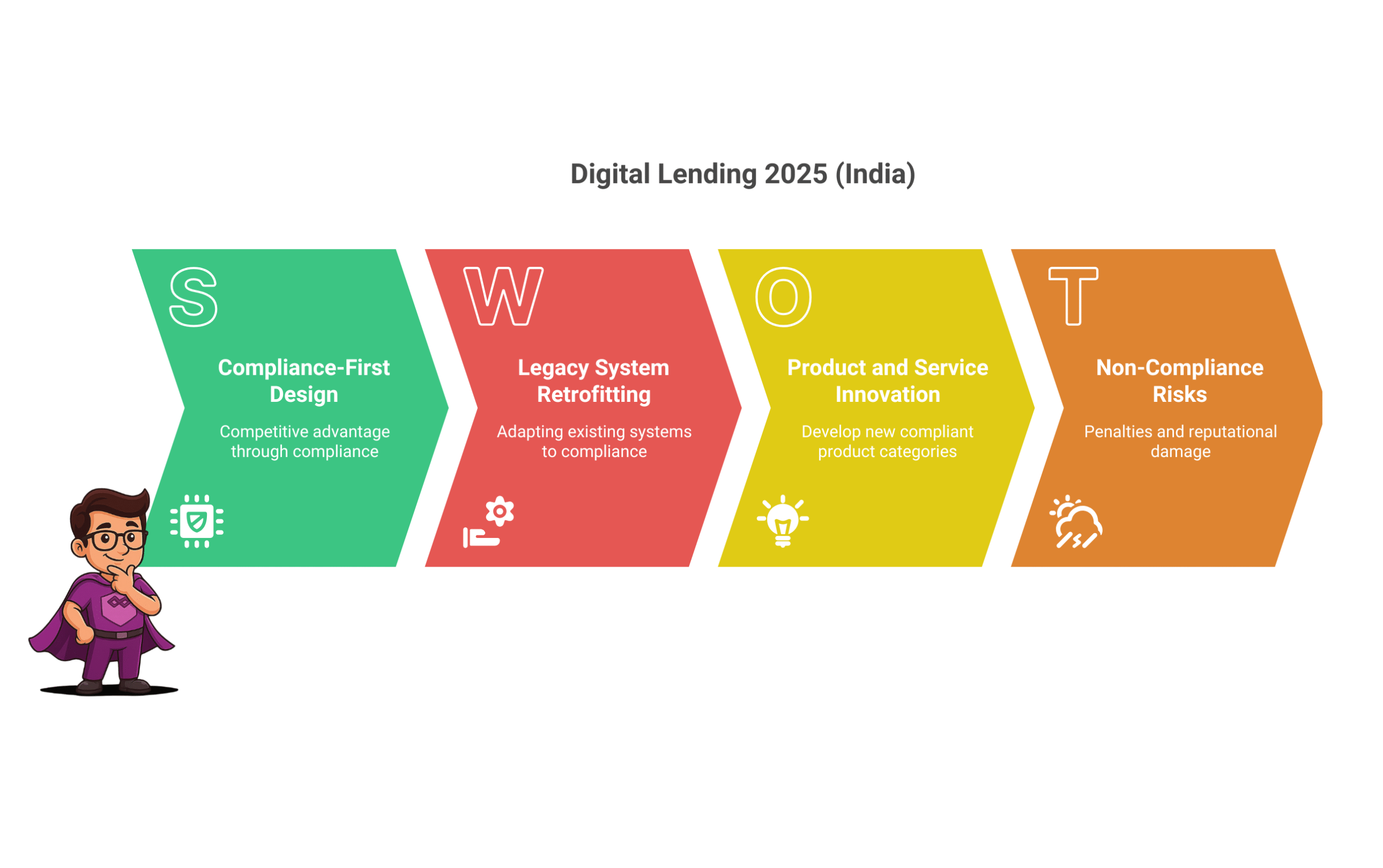
This means your technology stack, product design, and business processes must be built with compliance at the core, not bolted on as an external layer. The companies that understand this shift early will have a massive advantage over those trying to retrofit compliance into existing systems.
Breaking Down the New Framework: What Every Digital Lender Must Know
Regulated Entities and Scope
The 2025 Directions apply to all commercial banks, primary cooperative banks, state cooperative banks, central cooperative banks, all non-banking financial companies including housing finance companies, and all-India financial institutions. If you are lending digitally in India, these rules apply to you.
Default Loss Guarantee: The 5% Cap Revolution
The most immediate impact comes from the DLG framework. DLG cover is now capped at 5% of the disbursed portfolio and must be in the form of cash, fixed deposits, or bank guarantees. This fundamentally changes how Lending Service Providers (LSPs) can structure their partnerships with banks and NBFCs.
Key implications:
- No revolving credit or credit card DLGs are permitted
- DLG must be invoked within 120 days of default unless repaid
- Once invoked, a guarantee cannot be reinstated
For digital lending platforms, this means you need robust systems to:
- Track DLG utilization in real-time across your portfolio
- Automate DLG invocation within the 120-day window
- Maintain separate accounting for different portfolio segments
- Ensure your underwriting does not rely on DLG as a substitute for proper risk assessment
LSP Governance: The New Accountability Framework
LSPs can no longer collect fees directly from borrowers; REs must compensate them separately. This creates a complete restructuring of revenue flows in digital lending partnerships.
Importantly, LSPs are now under RBI oversight through their contractual arrangements with REs. This means if you are an LSP, your compliance posture directly impacts your banking partners’ regulatory standing.
The operational changes required:
- Complete separation of customer-facing fees from LSP compensation
- Transparent fee structures that cannot be bundled or hidden
- Clear contractual frameworks that define compliance responsibilities
- Joint liability structures between REs and LSPs for regulatory violations
CIMS Registration: Your Ticket to Legitimacy
All REs must report their Digital Lending Apps on RBI’s CIMS portal by June 15, 2025. The RBI will make this list publicly accessible, allowing users to verify app legitimacy.
This is not just a reporting requirement—it is a fundamental shift toward transparency that will reshape customer trust and market dynamics. REs are responsible for the accuracy and timely submission of this information, which will be published by RBI without further validation.
The strategic implications:
- Apps not registered on CIMS will lose customer trust and face regulatory action
- Public visibility means reputational risks are amplified
- Accuracy of reporting becomes critical as errors will be publicly visible
- Chief Compliance Officers must certify the accuracy of DLA data on CIMS portal
The Cooling-Off Period: Redefining Customer Experience
Borrowers now have a “cooling-off period”, determined by the RE’s board with a minimum of one day, to exit loans without penalties except a nominal processing fee. This seemingly simple requirement creates complex operational challenges.
Your platform must now handle:
- Dynamic cooling-off periods based on different REs’ board decisions
- Automated loan cancellation processes
- Refund mechanisms for disbursed amounts
- Clear communication of cooling-off rights to customers
- Systems to prevent LSPs from charging fees during this period
Key Metrics for Compliant Growth: What to Track
To scale successfully under the new framework, you need to monitor compliance metrics alongside business metrics. Here are the critical KPIs:
Complaint Rate Metrics
- Customer complaints per 1000 loans disbursed
- Resolution time for complaints
- Complaint categories trending analysis
- LSP vs direct RE complaint ratios
Mis-selling Detection Flags
- Loan approval to complaint correlation
- Product complexity vs customer profile mismatches
- Excessive fee structures detection
- Inappropriate target customer segments
NPA Performance by Channel
- Direct RE channels vs LSP channel NPA rates
- DLG invocation frequency by LSP
- Portfolio performance within the 5% DLG cap
- Time to default analysis by acquisition channel
Approval TAT (Turnaround Time) Compliance
- End-to-end approval times including cooling-off periods
- System downtime impact on approval processes
- Compliance check delays in approval workflows
- Customer drop-off rates during compliance processes
Product and Compliance Co-Design: The Winning Strategy
The most successful digital lenders in 2025 will be those that redesign their products with compliance as a core feature, not a constraint. This means:
Embedded Compliance Workflows
- Real-time DLG utilization tracking in loan origination systems
- Automated cooling-off period management
- Integrated KYC and customer verification processes
- Built-in fee transparency and disclosure mechanisms
Transparent Pricing Architecture
- Clear separation of RE fees and LSP compensation
- Automated fee calculation and disclosure
- Dynamic pricing based on regulatory requirements
- Customer-friendly fee explanations and comparisons
Risk Management Integration
- DLG-conscious underwriting models
- Real-time portfolio monitoring for regulatory limits
- Automated early warning systems for compliance breaches
- Integrated stress testing for different regulatory scenarios
Platform Changes: Technical Architecture for Compliance
Your technology platform needs fundamental changes to support compliant growth:
Data Architecture Updates
- Separate data streams for customer fees and LSP compensation
- Real-time regulatory reporting capabilities
- Audit trails for all compliance-related decisions
- Integration with CIMS reporting requirements
Workflow Management Systems
- Automated cooling-off period processing
- DLG invocation and management workflows
- Compliance approval chains before loan disbursement
- Exception handling for regulatory violations
Customer Interface Redesign
- Clear fee disclosure interfaces
- Cooling-off period communication systems
- Complaint management and resolution portals
- Transparent loan terms and condition displays
Partner Integration Frameworks
- LSP compliance monitoring systems
- RE partner compliance score tracking
- Automated partner compliance reporting
- Joint compliance dashboard for all stakeholders
Special Considerations: Salary-Linked Loans and Recovery
The 2025 Directions provide two exceptions to strict fund flow requirements: salary-linked loans where repayment is routed through the employer (provided LSPs have no control), and cash recovery in delinquency cases.
These exceptions create opportunities for specialized product development:
Salary-Linked Product Innovation
- Direct employer integration for repayment
- Reduced LSP involvement in fund flows
- Enhanced underwriting based on employment stability
- Streamlined approval processes for verified employees
Delinquency Management Systems
- Compliant cash recovery processes
- Clear documentation of delinquency status
- Automated escalation to permitted recovery methods
- Transparent customer communication during recovery
The Competitive Advantage of Compliance-First Design
Companies that build compliance into their core architecture will have several advantages:
Operational Efficiency
- Reduced compliance costs through automation
- Faster regulatory approvals for new products
- Lower legal and regulatory risk exposure
- Streamlined audit and inspection processes
Market Position
- Enhanced customer trust through CIMS registration
- Better partner relationships with REs
- Regulatory goodwill for future product innovations
- Competitive differentiation through transparent practices
Scalability
- Systems designed to handle regulatory complexity
- Easier expansion into new product categories
- Reduced integration costs with banking partners
- Future-proof architecture for regulatory changes
Implementation Roadmap: Getting Compliant Fast
For companies looking to implement compliant growth strategies:
Immediate Actions (Next 30 Days)
- Complete CIMS registration if not already done
- Audit current DLG arrangements for 5% compliance
- Implement cooling-off period in loan processes
- Separate customer fees from LSP compensation systems
Short-term Improvements (Next 90 Days)
- Redesign product offerings for transparent pricing
- Implement real-time compliance monitoring systems
- Establish CCO certification processes
- Create customer complaint management systems
Long-term Strategic Changes (Next 6-12 Months)
- Complete platform redesign for compliance-first architecture
- Develop new product categories within regulatory framework
- Build advanced analytics for compliance metrics
- Establish industry-leading compliance practices
The Road Ahead: Compliance as Competitive Strategy
The RBI’s Digital Lending Directions 2025 are not obstacles to growth—they are the foundation for sustainable, trustworthy digital lending in India. The companies that recognize this shift and build compliance into their core DNA will not just survive the new regulatory environment; they will use it as a competitive moat against less compliant competitors.
The digital lending market in India is still massive and growing. The winners in this new era will be those who understand that compliance is not a cost center—it is a strategic advantage that enables sustainable scale, customer trust, and regulatory partnership.
The choice is clear: adapt your architecture, redesign your products, and build compliance as a core competency, or risk being left behind by competitors who understand that in digital lending 2025, compliance is not just about following rules—it is about building better businesses.
Your customers, regulators, and investors are all watching. The question is not whether you will comply with the new directions—it is whether you will use them to build a stronger, more sustainable business that can scale with confidence in India’s digital lending future.
The framework is set, the rules are clear, and the opportunity is massive. The only question left is: are you ready to make compliance your competitive advantage?

Why 70%+ CRM Projects Fail…
Why 70%+ CRM Projects Fail — And How Next-Gen Architecture Changes Outcomes January 15, 2026…

Hyper-Personalization as a Competitive Advantage…
Hyper-Personalization as a Competitive Advantage in 2026 January 14, 2026 1:40 pm Adil Gouri Retail…

Salesforce’s Next Frontier: Agentic AI…
Salesforce’s Next Frontier: Agentic AI & Self-Executing Workflows January 14, 2026 11:50 am Darpan Karanje…
