

The renewable energy sector is experiencing unprecedented growth, with solar farms, wind turbines, and battery storage facilities popping up across the globe. But here’s the challenge: as operators scale their portfolios, managing thousands of distributed assets becomes exponentially complex. The old way of tracking performance, maintenance schedules, and operational data through spreadsheets and disconnected systems simply doesn’t cut it anymore.
Enter digital platforms. Today’s renewable energy operators are discovering that the right technology infrastructure can transform how they monitor, maintain, and maximize the performance of their assets. And the results speak for themselves: reduced downtime, optimized maintenance costs, and significantly improved energy output.
The Growing Complexity of Renewable Asset Management
Managing renewable energy assets isn’t like managing traditional power plants. We’re talking about geographically dispersed installations, each with hundreds or thousands of individual components that need constant monitoring. A single wind farm might have dozens of turbines, each with its own performance profile, maintenance requirements, and potential failure points.
The data challenge alone is staggering. Modern renewable installations generate massive amounts of real-time performance data, weather information, grid connection metrics, and maintenance logs. Without a centralized platform to make sense of all this information, operators are essentially flying blind, reacting to problems instead of preventing them.
What’s more, today’s energy markets demand agility. Operators need to respond quickly to changing grid conditions, optimize energy delivery based on market prices, and demonstrate performance to investors and stakeholders. Manual processes and siloed data systems make this nearly impossible.
How Digital Platforms are Transforming Operations
Digital asset management platforms are changing the game by bringing all operational data into a single, intelligent system. Think of it as a command center that gives operators complete visibility into every asset in their portfolio, no matter where it’s located.
These platforms connect directly to the sensors and monitoring systems already installed on renewable assets. They collect performance data in real time, analyze it using advanced algorithms, and surface actionable insights that help operators make better decisions faster. When a wind turbine shows early signs of bearing wear, the system flags it immediately. When solar panel performance drops below expected levels, operators know within minutes, not days.
The predictive maintenance capabilities are particularly powerful. Instead of scheduling maintenance based on fixed intervals or waiting for equipment to fail, operators can take a data-driven approach. The platform identifies patterns that indicate potential failures, allowing teams to address issues during planned maintenance windows rather than dealing with costly emergency repairs.
Beyond maintenance, digital platforms enable portfolio-wide optimization. Operators can compare performance across sites, identify best practices, and replicate success. They can forecast energy production more accurately, helping with grid planning and revenue projections. And when issues do arise, troubleshooting becomes faster because all the relevant data and historical context is immediately available.
Real Results: Efficiency Gains in Action
The impact of digital platforms on renewable operations is measurable and significant. Operators who have implemented comprehensive asset management platforms report substantial improvements across multiple metrics.
Unplanned downtime typically drops by 20 to 30 percent as predictive maintenance catches issues before they become failures. This directly translates to more uptime and higher energy generation. One solar operator found that early detection of inverter issues alone increased their annual production by nearly 3 percent across their portfolio.
Maintenance costs also see notable reductions. By shifting from reactive to predictive maintenance, operators avoid expensive emergency repairs and extend equipment lifespan. Technicians spend less time diagnosing problems because the platform has already identified the likely cause, complete with relevant historical data and recommended solutions.
Perhaps most importantly, digital platforms improve decision-making at the strategic level. Portfolio managers can quickly assess which assets are underperforming and why, enabling targeted investments in upgrades or optimization. Financial teams get accurate, real-time data for reporting to investors and lenders. And operations teams can allocate resources more effectively, focusing attention where it’s needed most.
Breaking Down Data Silos for Better Collaboration
One of the less obvious but equally important benefits of digital platforms is how they improve collaboration across teams. In traditional setups, operations teams work in their systems, maintenance crews have their own tools, and finance uses completely different software. Critical information gets trapped in silos, leading to miscommunication and missed opportunities.
A unified digital platform breaks down these barriers. Everyone works from the same data source, ensuring alignment across the organization. When a maintenance technician logs work on a turbine, that information is immediately available to operations managers tracking performance and finance teams monitoring costs. Field teams can access the information they need on mobile devices, updating records in real time rather than filing paperwork later.
This connected approach also extends to external stakeholders. Asset owners and investors can access customized dashboards showing portfolio performance. Equipment manufacturers can be given secure access to monitor their products and provide proactive support. The entire ecosystem becomes more efficient when everyone has access to accurate, timely information.
The Salesforce Advantage in Renewable Energy Operations
So where does Salesforce fit into this picture? Many renewable energy operators are discovering that Salesforce’s platform offers exactly the capabilities they need to manage their increasingly complex operations.
Salesforce Energy and Utilities Cloud provides a foundation specifically designed for energy sector needs. It connects operational technology with business systems, creating that crucial single source of truth. Asset performance data flows directly into the same platform managing customer relationships, service operations, and business intelligence.
The Service Cloud component becomes the backbone of maintenance operations. Work orders are automatically generated based on performance data or scheduled maintenance needs. Field service technicians get mobile access to asset histories, maintenance procedures, and real-time performance metrics. And because everything is connected, resolving issues becomes faster and more efficient.
For portfolio management and analytics, Salesforce’s Einstein AI capabilities bring predictive insights to renewable operations. The platform can identify performance anomalies, forecast maintenance needs, and recommend optimization strategies based on historical patterns and real-time data. These aren’t theoretical possibilities; they’re features operators are using today to drive measurable improvements.
Perhaps most valuable is Salesforce’s ecosystem approach. The platform integrates seamlessly with the specialized monitoring systems and SCADA platforms that renewable operators already use. Rather than replacing existing investments, Salesforce acts as the connective tissue that brings everything together, adding a layer of intelligence and workflow automation on top.
The flexibility to customize workflows, automate routine tasks, and scale as portfolios grow makes Salesforce particularly well-suited to the dynamic renewable energy sector. As operators add new sites or asset types, the platform adapts without requiring wholesale system changes.
The Path Forward: Making Digital Transformation Work for You
The renewable energy sector stands at a critical juncture. As portfolios expand and operational complexity grows, the gap between operators using modern digital platforms and those relying on legacy systems will only widen. The data is compelling: reduced downtime, optimized maintenance costs, and improved energy output aren’t aspirational goals but proven outcomes that forward-thinking operators are already achieving.
The good news is that digital transformation doesn’t require ripping out existing systems or halting operations. Platforms like Salesforce integrate with the monitoring and control systems you already have in place, adding intelligence and connectivity without disruption. Start with a pilot project on a single site or asset class, demonstrate value, then scale across your portfolio.
For decision-makers evaluating their next move, consider this: every day without integrated asset management is a day of missed insights, reactive maintenance, and suboptimal performance. Your competitors are already gaining ground with digital platforms that turn data into action.
The renewable energy transition needs efficient, reliable operators who can maximize every kilowatt-hour produced. Digital asset management platforms give you the tools to be that operator. The technology is proven, the results are measurable, and the time to act is now. Your assets are already generating the data; the question is whether you’re using it to drive the efficiency and profitability your business deserves.
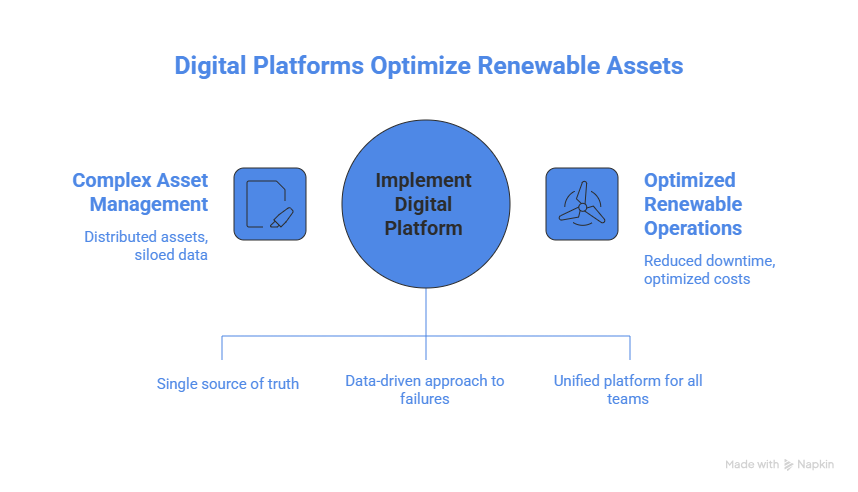
Key Takeaways for Business Leaders
Before we wrap up, here are two critical insights that every decision-maker in the renewable energy space should consider when evaluating digital asset management strategies.
First, the ROI of digital platforms extends far beyond operational savings. While reduced maintenance costs and increased uptime are immediate and measurable benefits, the strategic advantages run deeper. Unified platforms improve your ability to attract investment by providing transparent, real-time performance data. They enhance your competitive position when bidding for new projects by demonstrating operational excellence. And they future-proof your business as regulatory requirements and reporting standards become more stringent. The question isn’t just about saving money today but about building a foundation for sustainable growth tomorrow.
Second, integration complexity is no longer a valid barrier to adoption. Modern platforms like Salesforce are designed specifically to work alongside your existing systems rather than replace them. The technology has matured to the point where implementations can be phased, risks can be minimized, and value can be demonstrated quickly. Many operators start with a single use case like predictive maintenance or field service optimization, prove the concept, and then expand. This approach reduces risk while building organizational buy-in and expertise. The learning curve exists, but it’s manageable and the payoff is substantial.
Conclusion
The renewable energy industry is evolving rapidly, and operational excellence is no longer optional. Digital asset management platforms have moved from innovative experiments to mission-critical infrastructure that separates industry leaders from those struggling to keep pace.
The evidence is clear across every metric that matters. Operators using integrated platforms see measurable improvements in uptime, maintenance efficiency, and overall portfolio performance. More importantly, they gain the agility to respond to market changes, the transparency to satisfy stakeholders, and the insights to make confident strategic decisions.
For business leaders evaluating their options, the path forward is straightforward. Start by identifying your most pressing operational challenge whether that’s unplanned downtime, maintenance costs, or portfolio visibility. Implement a focused solution that addresses that pain point, measure the results, and build from there. Platforms like Salesforce offer the flexibility to start small and scale as you prove value.
The renewable energy transition depends on operators who can deliver reliable, cost-effective power at scale. Digital platforms provide the foundation to meet that challenge. Your competitors are already investing in these capabilities. The question is no longer whether to embrace digital transformation, but how quickly you can implement it to maintain your competitive edge and capitalize on the massive growth opportunities ahead.

Why 70%+ CRM Projects Fail…
Why 70%+ CRM Projects Fail — And How Next-Gen Architecture Changes Outcomes January 15, 2026…

Hyper-Personalization as a Competitive Advantage…
Hyper-Personalization as a Competitive Advantage in 2026 January 14, 2026 1:40 pm Adil Gouri Retail…

Salesforce’s Next Frontier: Agentic AI…
Salesforce’s Next Frontier: Agentic AI & Self-Executing Workflows January 14, 2026 11:50 am Darpan Karanje…
