
From Manual to Magical: How FinTech Companies Use Salesforce AI to Transform Collections
The collections industry is experiencing a seismic shift. While most organizations still rely on human agents making countless phone calls, forward-thinking companies are deploying AI-powered bots that integrate seamlessly with WhatsApp and Salesforce CRM triggers, achieving remarkable cost reductions of up to 40%. The question isn’t whether this transformation will happen—it’s whether your organization will lead or follow.
The Current State: Why Manual Collections Are Failing
The Human Agent Bottleneck
Traditional collections operations are plagued by inefficiencies that seem almost archaic in today’s digital age. Human agents spend hours each day making outbound calls, often reaching voicemails, disconnected numbers, or unresponsive debtors. The average collections agent can only handle 50-80 accounts per day, with success rates hovering around 15-20% for first-contact resolutions.
This manual approach creates several critical problems:
Scalability Limitations: As portfolios grow, organizations must hire more agents, increasing overhead costs and training complexity. Each new hire requires weeks of training and months to reach full productivity.
Inconsistent Messaging: Human agents, despite training, deliver inconsistent messages and may not always follow compliance protocols perfectly. This variability can lead to regulatory issues and damaged customer relationships.
Limited Operating Hours: Traditional call centers operate during business hours, missing opportunities to connect with debtors who may only be available during evenings or weekends.
High Operational Costs: Between salaries, benefits, training, technology, and facility costs, the total cost per agent can exceed $60,000 annually, not including the productivity losses from sick days, vacation time, and turnover.
The Communication Gap
Perhaps most critically, traditional collections methods fail to meet modern consumer communication preferences. Studies show that 75% of consumers prefer text-based communication over phone calls, yet most collections operations remain phone-centric. This disconnect creates friction that reduces payment rates and increases customer frustration.
The AI Revolution: Transforming Collections Through Intelligent Automation
Understanding AI Collections Bots
AI collections bots represent a fundamental shift from reactive to proactive collections management. These sophisticated systems leverage natural language processing, machine learning, and integration capabilities to automate the entire collections workflow while maintaining personalization and compliance.
Modern AI bots can analyze debtor profiles, payment histories, and behavioral patterns to craft personalized outreach strategies. They understand context, respond to objections, negotiate payment arrangements, and seamlessly escalate complex cases to human agents when necessary.
The Power of Multi-Channel Integration
The most successful AI collections implementations combine multiple communication channels with robust CRM integration:
WhatsApp Business Integration: With over 2 billion users worldwide, WhatsApp has become the preferred communication channel for many consumers. AI bots can initiate conversations, send payment reminders, share payment links, and even process payments directly within the chat interface.
Salesforce CRM Triggers: Integration with Salesforce enables sophisticated workflow automation. When specific conditions are met—such as a payment becoming 30 days overdue—the system automatically triggers personalized bot outreach sequences tailored to the debtor’s profile and history.
SMS and Email Backup: For comprehensive coverage, AI bots can seamlessly switch between channels based on response rates and customer preferences, ensuring maximum engagement.
Real-World Impact: The 40% Cost Reduction Reality
Breaking Down the Cost Savings
Organizations implementing AI collections bots report average cost reductions of 40%, but understanding where these savings come from reveals the true power of automation:
Reduced Labor Costs (60% of savings): AI bots can handle the workload of multiple human agents simultaneously. A single bot can manage thousands of accounts, working 24/7 without breaks, sick days, or vacation time.
Increased Collection Rates (25% of savings): By reaching debtors through their preferred communication channels at optimal times, AI bots often achieve higher contact and payment rates than traditional methods.
Operational Efficiency (15% of savings): Automated workflows eliminate manual data entry, reduce processing time, and minimize errors, creating significant operational efficiencies.
Case Study: Regional Credit Union Success
A regional credit union with 50,000 members implemented an AI collections bot integrated with WhatsApp and Salesforce. Within six months, they achieved:
-
- 45% reduction in collections operational costs
- 35% increase in first-contact payment rates
- 60% reduction in accounts requiring human agent intervention
- 90% customer satisfaction rate with the bot interaction experience
The bot handled over 10,000 collection cases monthly, with human agents focusing only on complex negotiations and legal proceedings.
Building Your AI Collections Bot: A Strategic Framework
Phase 1: Foundation and Planning
Compliance First Approach: Before any technical development, ensure your AI bot framework complies with all relevant regulations including the Fair Debt Collection Practices Act (FDCPA), Telephone Consumer Protection Act (TCPA), and state-specific collection laws. Build compliance into the bot’s core logic, not as an afterthought.
Data Integration Strategy: Successful AI collections bots require comprehensive data integration. Connect your existing systems including core banking platforms, loan management systems, payment processors, and customer databases to create a unified view of each debtor’s situation.
Communication Channel Setup: Establish your multi-channel communication infrastructure. Set up WhatsApp Business API access, configure SMS gateways, and ensure email deliverability. Each channel requires specific setup and compliance considerations.
Phase 2: Salesforce CRM Integration
Trigger Configuration: Design sophisticated trigger rules within Salesforce that initiate bot sequences based on specific criteria such as:
-
- Days past due thresholds
- Payment amount and frequency patterns
- Previous contact history and responses
- Customer risk scores and segmentation
- Seasonal or economic factors
Workflow Automation: Create automated workflows that update customer records, log interactions, schedule follow-ups, and escalate cases based on bot interactions. This integration ensures seamless handoffs between automated and human processes.
Real-Time Sync: Implement real-time data synchronization between your bot platform and Salesforce to ensure agents have immediate access to all bot interactions when they need to intervene.
Phase 3: AI Bot Development
Natural Language Processing: Develop or integrate NLP capabilities that can understand customer responses, detect payment intent, identify hardship situations, and respond appropriately. The bot should handle common scenarios like payment confirmations, dispute notifications, and arrangement requests.
Personalization Engine: Build dynamic message generation capabilities that personalize communications based on customer data, payment history, and previous interactions. Personalized messages consistently outperform generic templates.
Payment Integration: Integrate secure payment processing directly into the bot experience. Customers should be able to make payments, set up payment plans, or update payment methods without leaving the conversation.
Phase 4: Advanced Features and Optimization
Predictive Analytics: Implement machine learning models that predict payment likelihood, optimal contact timing, and most effective communication strategies for each debtor profile.
Sentiment Analysis: Add sentiment analysis capabilities to detect customer frustration, hardship indicators, or satisfaction levels, allowing the bot to adjust its approach accordingly.
Continuous Learning: Design feedback loops that allow the bot to learn from successful interactions and continuously improve response strategies.
Measuring Success: Key Performance Indicators
Operational Metrics
Contact Rates: Measure the percentage of debtors successfully contacted through bot outreach compared to traditional methods.
Resolution Rates: Track the percentage of cases resolved without human intervention, broken down by case complexity and debtor characteristics.
Response Time: Monitor how quickly bots respond to customer inquiries and process payment arrangements.
Financial Impact
Cost Per Case: Calculate the total cost of processing each collections case, including technology, personnel, and operational expenses.
Recovery Rates: Measure the percentage of outstanding debt recovered through bot-initiated processes.
Time to Resolution: Track how quickly cases move from initial contact to resolution or payment arrangement.
Customer Experience
Satisfaction Scores: Survey customers about their experience with bot interactions and compare to traditional collections experiences.
Complaint Rates: Monitor customer complaints related to bot interactions and address any systemic issues.
Channel Preference: Track which communication channels customers prefer and optimize bot deployment accordingly.
The Future of AI Collections
Emerging Technologies
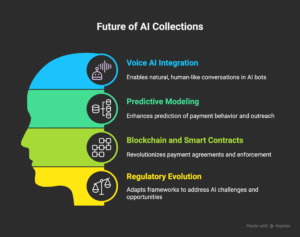
Voice AI Integration: Advanced voice processing capabilities will soon enable AI bots to handle phone calls with natural, human-like conversations while maintaining perfect compliance.
Predictive Modeling: Machine learning models will become increasingly sophisticated at predicting payment behavior and optimizing outreach strategies.
Blockchain and Smart Contracts: Automated payment arrangements and enforcement through blockchain technology may revolutionize how payment agreements are created and managed.
Regulatory Evolution
As AI becomes more prevalent in collections, regulatory frameworks will evolve to address new challenges and opportunities. Organizations implementing AI collections systems today will be better positioned to adapt to future regulatory requirements.
The collections industry stands at a crossroads. Organizations that embrace AI-powered automation today will gain significant competitive advantages through reduced costs, improved customer experiences, and enhanced operational efficiency. Those that continue relying solely on manual processes will find themselves increasingly disadvantaged.
The technology exists today to achieve 40% cost reductions while improving collection rates and customer satisfaction. The integration of AI bots with WhatsApp and Salesforce CRM triggers represents proven technology that forward-thinking organizations are already deploying successfully.
The question isn’t whether AI will transform collections—it’s whether your organization will be among the leaders or followers in this transformation. The time to act is now, while competitive advantages can still be gained and operational efficiencies can provide immediate bottom-line impact.
By embracing AI collections bots, organizations don’t just reduce costs—they transform their entire approach to customer engagement, creating more positive interactions while achieving better financial outcomes. The future of collections is automated, intelligent, and customer-centric. The organizations that recognize this reality and act accordingly will thrive in the evolving financial services landscape.
