

The corporate world is experiencing a fundamental shift in how companies source their electricity. As climate commitments become more than just marketing speak, businesses are discovering that renewable energy procurement is no longer optional. It is essential to competitive advantage, operational resilience, and long-term sustainability.
At the forefront of this transformation stands Salesforce, a company that has turned ambitious climate pledges into tangible action. Through innovative procurement strategies, collaborative frameworks, and technology-driven solutions, Salesforce is not just meeting its own renewable energy goals but also reshaping how corporations across industries approach clean power procurement.
From Commitment to Action: Salesforce’s Renewable Energy Journey
Salesforce made its first public commitment to reach 100% renewable energy in 2013, meaning the company would purchase renewable energy and certificates equivalent to the amount of power used in its global operations every year. What started as a bold promise has evolved into a sophisticated strategy that addresses not just the quantity of renewable energy purchased, but the quality and impact of those purchases.
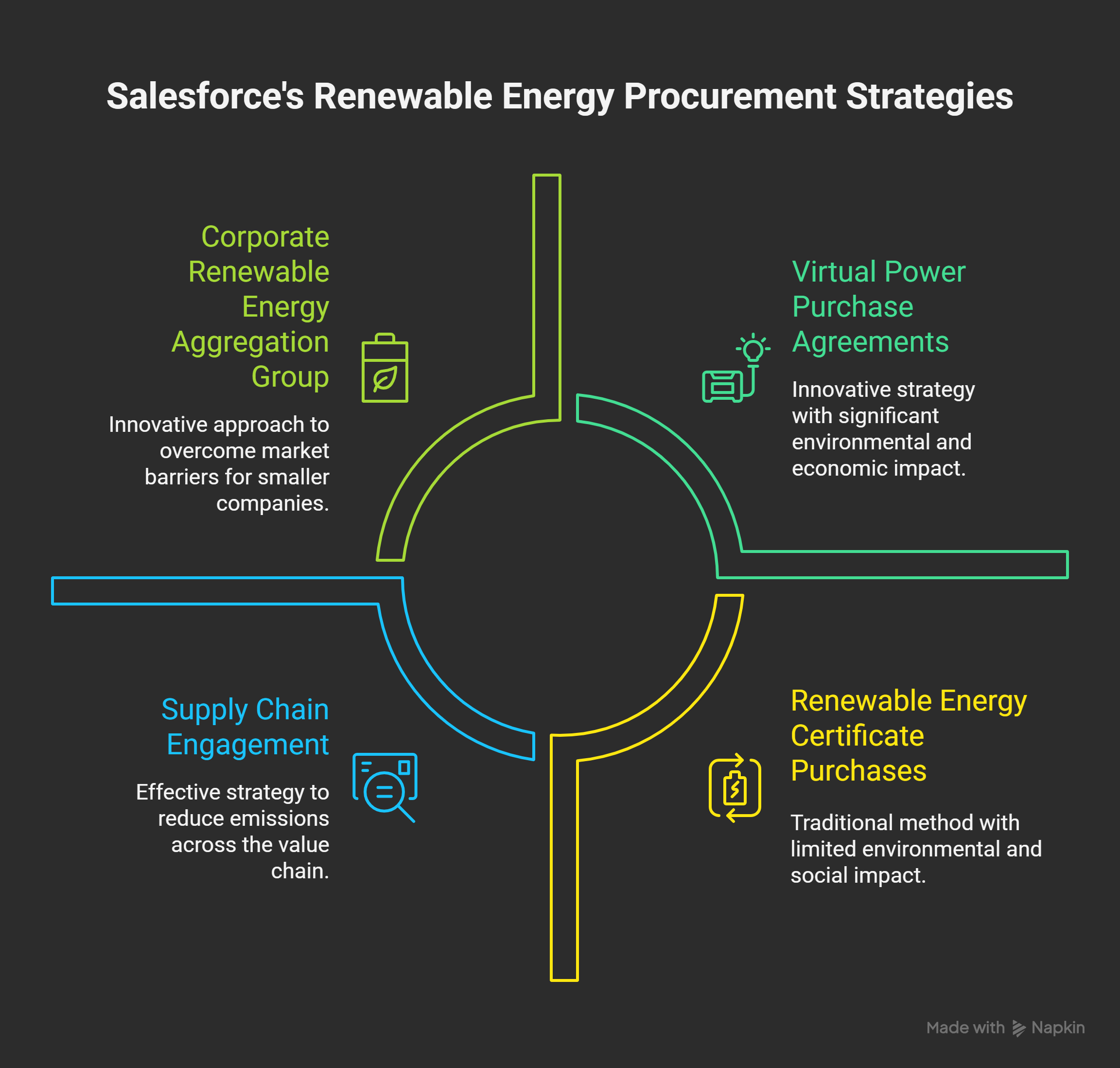
The company recently announced a 15-year virtual power purchase agreement with Qualitas Energy to deliver a new solar portfolio across six Italian regions, expected to generate enough electricity to power over 4,200 homes annually and save over 21,500 metric tons of carbon emissions each year. This marks Salesforce’s first European virtual power purchase agreement, demonstrating how the company is expanding its renewable energy footprint globally while driving real environmental impact.
But Salesforce’s approach goes beyond simply buying the cheapest renewable energy available. The company developed a procurement matrix to evaluate renewable energy projects against transactional, economic, environmental and social criteria, recognizing that not all renewable energy is created equal and that two projects with identical transactional details can have enormously different impacts.
Breaking Down Barriers Through Collaboration
One of Salesforce’s most innovative contributions to corporate renewable energy procurement has been its collaborative approach to solving market barriers. Many companies want to purchase renewable energy but find themselves locked out of favorable procurement options because their energy needs are too small to anchor large renewable energy projects independently.
Salesforce addressed this by working with partners to create one of the first examples of companies aggregating similar, relatively small amounts of renewable energy demand to enter into a virtual power purchase agreement collectively, acting as the anchor tenant for a large offsite renewable energy project. Through the Corporate Renewable Energy Aggregation Group, which includes companies like Bloomberg, Cox Enterprises, and Gap Inc., Salesforce demonstrated that smaller buyers can pool their demand and support large-scale projects in the same impactful way larger companies do.
This aggregation model has profound implications for the market. It allows companies just starting their renewable energy journey to pilot virtual power purchase agreements as a viable option to meet their climate goals while keeping transaction costs low. More importantly, it creates a blueprint for other corporations to follow, potentially unlocking billions of dollars in renewable energy demand that might otherwise remain untapped.
Driving Systemic Change Through Supply Chain Engagement
While direct renewable energy procurement addresses a company’s operational emissions, the majority of corporate carbon footprints often lie within supply chains. Salesforce recognized this reality and took decisive action. More than half of Salesforce’s most strategic suppliers have agreed to cut their greenhouse gas emissions as part of binding provisions in their contracts through the Salesforce Sustainability Exhibit, introduced in May 2021, which requires business partners to set science-based emissions reduction targets within two years of signing.
This contractual approach represents a significant shift in how corporations can influence emissions beyond their direct operations. Rather than treating sustainability as a nice-to-have feature in vendor selection, Salesforce made it a contractual requirement with real consequences for non-compliance. The initiative is part of Salesforce’s high-level pledge to cut the carbon footprint of its supply chain in half by fiscal year 2031, with the company committed to an absolute reduction of 50 percent for all emissions by 2030.
The ripple effects of this approach are substantial. Suppliers who might have delayed setting climate targets are now accelerating their efforts. Some suppliers have even reported that without Salesforce’s requirement, setting targets would have taken significantly longer or might not have happened at all.
Investing in the Future of Clean Energy Technology
Beyond traditional renewable energy procurement, Salesforce is placing strategic bets on emerging climate technologies that will be essential for reaching net-zero emissions. The company joined Frontier, an advance market commitment to collectively buy more than $1 billion of permanent carbon removal by 2030, committing $25 million to accelerate, scale, and commercialize the most promising carbon removal technologies.
This investment in carbon removal solutions reflects a mature understanding of climate action. While reducing emissions should always be the priority, achieving net-zero will ultimately require removing carbon from the atmosphere. By creating demand for carbon removal today, Salesforce is helping these critical technologies scale and become commercially viable.
During fiscal year 2024, Salesforce dedicated $10 million to climate justice grants, supporting 18 organizations globally, contributing to the conservation and restoration of over 11,000 hectares of land and catalyzing an estimated $225 million in additional funding. This philanthropic approach recognizes that the energy transition must be equitable and that communities often left behind must be active participants in clean energy solutions.
Navigating the Challenges of Rapid Growth
As Salesforce continues to expand its business, particularly with the explosive growth of artificial intelligence capabilities, the company faces new challenges in balancing growth with climate commitments. In 2024, the company’s emissions were just 1 percent below its 2018 baseline inventory of roughly 1 million metric tons, and while the company reached its 2030 reduction goals for Scope 1 and 2 two years ago, overall emissions from Scope 3 activities swelled 10 percent between 2019 and 2025.
This reality check highlights an important truth: achieving ambitious climate goals while scaling operations is extraordinarily difficult. The energy demands of AI and data centers are substantial, and as these technologies become central to business operations across industries, managing their environmental impact becomes critical.
Rather than abandon its commitments, Salesforce has adapted its approach, demonstrating the kind of flexibility and pragmatism that will be essential for corporate climate action in an era of rapid technological change.
How Salesforce Technology Can Accelerate Your Renewable Energy Journey
For organizations inspired by Salesforce’s renewable energy leadership but uncertain where to begin, the good news is that the same technology platform can help accelerate your own clean energy transition. Salesforce offers solutions designed specifically to help businesses manage, track, and optimize their sustainability efforts.
Salesforce Net Zero Cloud provides companies with the tools to measure their carbon footprint across all scopes, set science-based targets, and track progress toward net-zero goals. The platform enables investor-grade reporting, supplier collaboration through Slack-First Sustainability, and climate action planning with forecasting and scenario modeling capabilities.
For organizations grappling with complex supply chains, the platform facilitates engagement with suppliers around emissions reduction targets, helping companies replicate the kind of supply chain transformation Salesforce achieved with its Sustainability Exhibit. Companies can collaborate securely at scale through Slack Connect, bringing transparency and accountability to Scope 3 emissions.
The platform also helps businesses navigate the rapidly evolving landscape of renewable energy procurement by providing data-driven insights into the most impactful strategies for their specific circumstances. Whether a company is ready to pursue virtual power purchase agreements, considering renewable energy certificate purchases, or exploring behind-the-meter generation, having accurate data and forecasting capabilities is essential for making informed decisions.
Most importantly, Salesforce technology helps businesses turn sustainability commitments into operational reality. Climate goals often fail not because of lack of intention but because of insufficient systems for tracking, measuring, and acting on emissions data. By centralizing sustainability management on a single platform, companies can embed climate considerations into everyday business decisions rather than treating them as separate initiatives.
The Broader Impact on Corporate Renewable Energy Procurement
Salesforce’s approach to renewable energy procurement has contributed to broader market transformation. Corporate buyers have led to the voluntary procurement of over 40% of the total capacity of U.S. solar and wind projects from 2014 to 2024, representing over 100 gigawatts of clean energy deals procured by corporate buyers. This corporate demand has become a primary driver of renewable energy growth, often leaping ahead of utility adoption.
Corporate procurement of renewable energy set a record in 2024, contracting 28 gigawatts, up 34 percent from 20.9 gigawatts in 2022, with tech companies accounting for 84 percent of overall deal activity. This surge in corporate procurement provides financial stability that helps renewable energy projects get built, even during periods of low wholesale power prices.
The impact extends beyond just adding renewable energy capacity to the grid. When companies like Salesforce insist on evaluating projects based on their full environmental and social impact, they raise the bar for the entire industry. Developers know that to win contracts from leading corporations, they need to demonstrate not just competitive pricing but also community benefits, environmental stewardship, and contribution to grid transformation.
Key Takeaways for Business Leaders
For executives and decision-makers considering their own renewable energy strategies, several lessons emerge from Salesforce’s journey. First, start with clear commitments but remain flexible in execution. The path to 100% renewable energy will require adapting strategies as markets evolve and new technologies emerge.
Second, collaboration creates opportunities that individual companies cannot achieve alone. Whether through procurement aggregation, industry initiatives, or supplier engagement, working with others amplifies impact and reduces barriers to entry.
Third, technology and data are essential enablers of climate action. Without robust systems for measuring, tracking, and reporting emissions, companies cannot effectively manage their transition to clean energy.
Finally, renewable energy procurement should be viewed not as a cost center but as a strategic investment in operational resilience, brand value, and long-term competitiveness. As energy markets evolve and climate regulations tighten, companies that have already built renewable energy procurement capabilities will have significant advantages over those still dependent on conventional electricity sources.
Conclusion
Salesforce’s renewable energy journey demonstrates that ambitious climate commitments can drive real change when backed by innovative strategies, collaborative approaches, and genuine commitment to impact. By developing new procurement models, engaging suppliers, investing in emerging technologies, and leveraging its own platform to drive sustainability outcomes, Salesforce has shown that corporate renewable energy procurement can be both environmentally impactful and commercially sound.
As businesses worldwide grapple with their own energy transitions, the framework Salesforce has developed offers a practical roadmap. Whether through aggregated procurement, comprehensive supplier engagement, or technology-enabled tracking and reporting, companies of all sizes can take meaningful steps toward clean energy goals.
The transition to 100% renewable energy is not just an environmental imperative but an economic opportunity. Companies that act now to build renewable energy procurement capabilities will be better positioned to navigate the energy markets of the future, meet stakeholder expectations, and contribute to the global transition to clean energy. The question is no longer whether to pursue renewable energy but how quickly and effectively your organization can make it happen.

Why 70%+ CRM Projects Fail…
Why 70%+ CRM Projects Fail — And How Next-Gen Architecture Changes Outcomes January 15, 2026…

Hyper-Personalization as a Competitive Advantage…
Hyper-Personalization as a Competitive Advantage in 2026 January 14, 2026 1:40 pm Adil Gouri Retail…

Salesforce’s Next Frontier: Agentic AI…
Salesforce’s Next Frontier: Agentic AI & Self-Executing Workflows January 14, 2026 11:50 am Darpan Karanje…
