
Leveraging AI & predictive analytics to move from reactive treatment to preventive healthcare

Leveraging AI & predictive analytics to move from reactive treatment to predictive treatment November 27, 2025 10:01 am Laxman Gore Healthcare has always been about fixing what’s broken. A patient shows symptoms, visits a doctor, gets diagnosed, and receives treatment. But what if we could predict health issues before they become serious problems? Thanks to artificial intelligence and predictive analytics, this shift from reactive treatment to preventive healthcare is not just possible anymore, it’s already happening. The healthcare industry is sitting on mountains of data from electronic health records, wearable devices, genetic testing, and medical imaging. The challenge has been making sense of all this information in real time. AI and predictive analytics are changing that equation, helping healthcare providers identify risks early, personalize care plans, and ultimately save lives while reducing costs. Why Preventive Healthcare Matters Now More Than Ever The traditional healthcare model is unsustainable. Chronic diseases like diabetes, heart disease, and cancer account for the majority of healthcare spending, yet many of these conditions are preventable or manageable if caught early. Hospitals are overcrowded, healthcare costs continue to rise, and physician burnout is at an all-time high. Preventive healthcare flips this model on its head. Instead of waiting for patients to get sick, healthcare providers can use data to predict who is at risk and intervene before conditions worsen. This approach not only improves patient outcomes but also reduces the financial burden on healthcare systems. Early intervention is almost always cheaper and more effective than treating advanced disease. The timing couldn’t be better. With the explosion of health data from smartwatches, fitness trackers, and remote monitoring devices, we now have unprecedented visibility into patient health outside clinical settings. AI can process this continuous stream of information to spot patterns that human clinicians might miss. How AI and Predictive Analytics Work in Healthcare At its core, predictive analytics uses historical data to forecast future events. In healthcare, this means analyzing patient records, lab results, imaging data, and even social determinants of health to predict disease risk. Machine learning algorithms can identify subtle patterns across millions of data points, patterns that would be impossible for humans to detect manually. For example, AI systems can analyze a patient’s medical history, lifestyle factors, genetic markers, and even environmental data to calculate their risk of developing conditions like Type 2 diabetes or cardiovascular disease. These risk scores help doctors prioritize interventions for high-risk patients, from lifestyle counseling to preventive medications. Natural language processing, a branch of AI, can scan through years of unstructured clinical notes to extract insights about a patient’s health trajectory. This technology can flag concerning trends, such as gradual weight gain or recurring symptoms that might indicate an emerging condition. The system essentially acts as a tireless assistant, continuously monitoring for warning signs. Computer vision powered by AI is revolutionizing medical imaging. Algorithms can detect early signs of cancer, retinal disease, or bone fractures with accuracy that matches or exceeds human radiologists. What makes this truly preventive is the speed and consistency. AI can screen thousands of images quickly, ensuring that subtle early-stage abnormalities don’t slip through the cracks. Real-World Applications Transforming Patient Care Healthcare organizations around the world are already implementing AI-driven preventive care programs with measurable results. Hospitals are using predictive models to identify patients at high risk for hospital readmission, allowing care teams to provide additional support and follow-up care that keeps people healthy at home. Chronic disease management has been transformed by continuous monitoring and AI analytics. Patients with conditions like congestive heart failure wear devices that track vital signs in real time. When the AI detects worrying trends, such as fluid retention or irregular heart rhythms, it alerts healthcare providers who can adjust treatment before the patient ends up in the emergency room. Cancer screening has become more targeted and effective. Instead of blanket screening protocols, AI can help determine which patients need more frequent or intensive screening based on their individual risk profiles. This personalized approach catches cancers earlier while reducing unnecessary procedures for low-risk individuals. Mental health is another frontier where predictive analytics is making a difference. By analyzing patterns in patient communication, social media activity, and self-reported mood data, AI systems can identify individuals at risk for mental health crises and connect them with appropriate resources before situations become critical. Overcoming Challenges and Building Trust Despite the enormous potential, the path to AI-powered preventive healthcare isn’t without obstacles. Data privacy and security are paramount concerns. Patients need assurance that their sensitive health information is protected, and healthcare organizations must comply with strict regulations while still leveraging data for insights. Algorithm bias is another critical issue. AI systems are only as good as the data they’re trained on. If training data doesn’t represent diverse populations, the resulting models may not work equally well for everyone. Healthcare organizations must prioritize developing and validating AI tools across different demographic groups to ensure equitable care. Clinical integration presents practical challenges too. Healthcare providers are already stretched thin, and introducing new technologies requires training, workflow changes, and demonstrated value. The most successful implementations focus on augmenting rather than replacing human judgment, positioning AI as a tool that makes clinicians more effective rather than obsolete. Building trust takes time. Patients and providers alike need to understand how AI recommendations are generated and feel confident in their reliability. Transparency in AI decision-making, combined with clear communication about the technology’s capabilities and limitations, is essential for widespread adoption How Salesforce Health Cloud Enables Preventive Care at Scale Moving to preventive healthcare requires more than just AI algorithms. It demands a unified platform that can integrate data from multiple sources, engage patients effectively, and coordinate care across teams. This is where Salesforce Health Cloud comes into play. Salesforce Health Cloud provides a 360-degree view of each patient by bringing together data from electronic health records, wearables, patient portals, and other sources into a single platform. This comprehensive patient profile is exactly what AI and predictive analytics need to generate
The Future of Banking Personalization: Hyper-Automated Financial Journeys with Salesforce FS Cloud

The Future of Banking Personalization: Hyper-Automated Financial Journeys with Salesforce FS Cloud November 27, 2025 8:02 am Aadinath The Future of Banking Personalization: Hyper-Automated Financial Journeys with Salesforce FS Cloud Banks aren’t struggling with a lack of data—they’re struggling with making it meaningful. Customers expect every interaction to feel as personalized as their favorite consumer apps, yet most financial journeys still feel generic, reactive, and disconnected. That gap between expectation and execution is exactly where the future of banking personalization is now being reshaped. Across the finance industry, institutions are under pressure to deliver more proactive, tailored guidance. Regulations demand transparency, competition from fintechs pushes speed, and customers expect financial advice that feels relevant to their real-time financial behavior. Traditional CRM systems weren’t built for this level of nuance. Today, personalization means knowing not just “who” the customer is, but “what” they’re trying to achieve—and doing something about it instantly. The challenge is that many banks still operate through a fragmented lens: siloed product teams, manual outreach, inconsistent servicing, and legacy systems that don’t talk to each other. Without a unified customer profile or automated decisioning, personalization becomes impossible. Agents are left guessing, marketing relies on static segments, and customers receive generic offers that don’t match their financial goals. This is where Salesforce Financial Services Cloud is redefining banking personalization through a business-outcome-driven lens. Instead of focusing on traditional CRM workflows, FS Cloud turns every interaction—across marketing, onboarding, lending, service, and advisory—into a connected, automated journey. With unified customer data models, Einstein AI recommendations, dynamic segmentation, and end-to-end process automation, banks can finally deliver personal experiences at scale without increasing operational load. The emphasis is on smarter operations, reduced friction, and quantifiable impact on customer growth and retention. Consider a retail bank helping a customer navigate their first home-loan journey. Today, that experience is often patchy: the customer browses online, submits partial applications, waits for callbacks, and receives repetitive requests for documents. With FS Cloud, the bank automatically identifies the customer’s digital signals, assigns a personalized path, surfaces tailored mortgage recommendations, triggers automated document requests, and provides advisors real-time visibility. The customer feels guided; the bank reduces manual cycles; the process accelerates itself. When hyper-automation and personalization converge, the benefits compound quickly. Banks see shorter onboarding cycles, less operational dependency on manual review, higher cross-sell conversion, and more consistent advisory quality across channels. Customers receive proactive alerts, relevant product suggestions, and contextual support—making the bank feel more like a financial partner than a transaction handler. Leadership gains line-of-sight into journey performance and can finally measure personalization outcomes instead of guessing. Looking ahead, the future of banking will be shaped by predictive automation—journeys that anticipate financial needs before the customer articulates them. AI-driven insights, unified experience layers, and adaptive workflows will replace static processes. Salesforce FS Cloud is positioned as a core enabler of this shift, helping financial institutions mature into ecosystems that are smarter, more responsive, and inherently customer-centric. If you’re exploring how Salesforce aligns with your digital transformation roadmap, we help financial organizations define their personalization strategy, optimize their CRM maturity, and convert Salesforce investments into measurable business outcomes. Latest Post 28Nov BlogsUtility AI-Powered Clinical Decision Support: The… AI-Powered Clinical Decision Support: The Next Leap with Agentforce and Salesforce Healthcare November 28, 2025… 28Nov BlogsIndustry Dealer Networks 2.0: How Salesforce… Dealer Networks 2.0: How Salesforce Is Redefining Manufacturing–Dealer Collaboration Dealer Networks 2.0: How Salesforce Is… 28Nov BlogsIndustry Using Salesforce Net Zero Cloud… Using Salesforce Net Zero Cloud to Track Scope 1, 2, and 3 Emissions—Even in Distributed…
What’s Next in Healthcare Tech? Key Trends via Salesforce’s Lens for 2025 & Beyond

What’s Next in Healthcare Tech? Key Trends via Salesforce’s Lens for 2025 & Beyond What’s Next in Healthcare Tech? Key Trends via Salesforce’s Lens for 2025 & Beyond November 13, 2025 11:50 am Laxman Gore Healthcare is at a crossroads. Patient expectations are rising, regulatory pressures are mounting, and the workforce is stretched thin. At the same time, technology is advancing faster than ever, promising solutions that seemed like science fiction just a few years ago. For healthcare leaders and decision-makers, the question isn’t whether to embrace digital transformation but how to do it strategically. As we look toward 2025 and beyond, several key trends are reshaping the healthcare landscape. Understanding these shifts isn’t just about staying current. It’s about positioning your organization to deliver better patient outcomes, streamline operations, and remain competitive in an increasingly tech-driven industry. The Rise of Hyper-Personalized Patient Experiences Gone are the days of one-size-fits-all healthcare. Today’s patients expect the same level of personalization they get from their favorite retail brands or streaming services. They want tailored treatment plans, proactive outreach, and communication on their preferred channels, whether that’s text, email, or a patient portal. This shift is driving healthcare organizations to rethink their entire patient journey. From the first appointment booking to post-treatment follow-ups, every touchpoint needs to feel seamless and personalized. The challenge is that healthcare data often lives in silos across different departments, electronic health records, billing systems, and communication platforms. Breaking down these silos to create a unified patient view is becoming essential, not optional. Organizations that succeed here aren’t just improving satisfaction scores. They’re seeing real clinical benefits too. Personalized care plans based on comprehensive patient data lead to better adherence, fewer readmissions, and improved health outcomes. The technology to make this happen exists today, but it requires a thoughtful approach to data integration and patient engagement strategies. Artificial Intelligence Moves from Pilot to Production AI in healthcare has moved well beyond the experimental phase. In 2025 and beyond, we’ll see AI embedded into everyday clinical and operational workflows. This isn’t about replacing healthcare professionals but augmenting their capabilities and freeing them from administrative burden. Clinical AI applications are becoming more sophisticated and reliable. We’re talking about algorithms that can analyze medical images with expert-level accuracy, predict patient deterioration before symptoms appear, and suggest treatment options based on the latest research and similar patient outcomes. The key difference now is that these tools are earning clinician trust and proving their value in real-world settings. On the operational side, AI is tackling some of healthcare’s most persistent challenges. Scheduling optimization, revenue cycle management, and supply chain logistics are all being transformed by intelligent automation. Healthcare administrators are finding that AI can handle routine inquiries, process claims faster, and even predict staffing needs based on patient volume patterns. The organizations leading this charge aren’t trying to implement AI everywhere at once. They’re identifying high-impact use cases, starting small, and scaling what works. They’re also being thoughtful about governance, ensuring their AI tools are transparent, fair, and compliant with healthcare regulations. Data Privacy and Security Take Center Stage As healthcare becomes more digital and interconnected, protecting patient data has never been more critical. Cyberattacks on healthcare organizations have surged, and the consequences go far beyond financial losses. A data breach can compromise patient safety, erode trust, and result in devastating regulatory penalties. The regulatory landscape is getting more complex too. Beyond HIPAA, organizations need to navigate state-level privacy laws, international regulations if they operate globally, and evolving standards around data sharing and interoperability. Compliance isn’t just a legal checkbox anymore. It’s a competitive differentiator and a fundamental part of patient trust. Forward-thinking healthcare organizations are treating security and privacy as core to their digital strategy, not an afterthought. This means investing in robust cybersecurity infrastructure, training staff on data handling best practices, and implementing privacy-by-design principles in every new technology deployment. It also means being transparent with patients about how their data is used and giving them meaningful control over their information. The Connected Care Ecosystem Expands Healthcare is becoming less hospital-centric and more distributed. Remote patient monitoring, telehealth, home-based care, and wearable devices are creating a connected care ecosystem that extends far beyond traditional care settings. This trend accelerated during the pandemic and shows no signs of slowing down. The opportunity here is enormous. Continuous monitoring can catch health issues earlier, reduce emergency room visits, and help patients manage chronic conditions from home. But making this work requires seamless data flow between devices, providers, payers, and patients themselves. It requires platforms that can collect, analyze, and act on data in real-time. Interoperability is the backbone of connected care. When a patient’s wearable device detects an irregular heartbeat, that information needs to flow quickly to their care team for review. When a patient visits a specialist, that doctor should have instant access to their complete medical history. These scenarios require technology platforms that can integrate diverse data sources and make information accessible to the right people at the right time. Value-Based Care Demands Better Data and Coordination The shift from fee-for-service to value-based care models is accelerating. Providers are increasingly being rewarded for keeping patients healthy, not just treating them when they’re sick. This fundamental change requires a completely different approach to data, coordination, and patient engagement. Value-based care only works when you can track patient outcomes across the entire care journey, identify at-risk populations before they become high-cost cases, and coordinate seamlessly between primary care, specialists, social services, and other stakeholders. The data requirements are substantial, and the coordination challenges are significant. Organizations thriving in value-based contracts are those that have invested in the infrastructure to support population health management. They can identify gaps in care, reach out proactively to patients who need interventions, and measure outcomes in ways that matter for both clinical quality and financial performance. How Salesforce Powers Healthcare’s Digital Future This is where platforms like Salesforce Health Cloud become game-changers for healthcare organizations navigating these trends. Rather
From Fragmented Systems to Unified Care: How Smart Integration Is Turning Healthcare’s AI Challenges Into a Multi-Billion Dollar Success Story

AI Revolution Stalled? How Salesforce Supercharges Healthcare’s Digital Leap to $419B Glory AI Revolution Stalled? How Salesforce Supercharges Healthcare’s Digital Leap to $419B Glory October 17, 2025 1:23 pm Himakhi Gogoi The healthcare industry stands at a crossroads. While artificial intelligence promised to transform patient care overnight, many organizations are discovering that adoption is messier than the headlines suggested. Yet amid the growing pains, there’s a $419 billion opportunity taking shape, and the companies getting it right are the ones combining smart technology with practical implementation strategies. If you’re a healthcare executive or IT decision-maker watching your AI investments plateau while competitors seem to be racing ahead, you’re not alone. The good news? The path forward is clearer than you think, and it starts with understanding why the revolution hit the brakes in the first place. The Promise vs. The Reality of Healthcare AI Healthcare was supposed to be AI’s poster child. Predictive diagnostics, personalized treatment plans, automated administrative workflows—the vision was compelling. Organizations invested heavily, expecting rapid transformation. But here’s what actually happened. Most healthcare systems found themselves drowning in disconnected data sources. Patient information lived in one system, billing in another, clinical notes somewhere else entirely. AI models are only as good as the data they’re trained on, and fragmented information creates fragmented results. The initial excitement gave way to frustration. Pilot programs showed promise but struggled to scale. Clinical staff resisted tools that didn’t fit their workflows. Regulatory concerns slowed deployment. The AI revolution didn’t stall because the technology failed. It stalled because implementation was harder than anyone anticipated. Why Healthcare Needs More Than Just AI The healthcare digital transformation market is projected to reach $419 billion, but capturing that value requires more than deploying algorithms. It demands a fundamental rethinking of how technology integrates with care delivery. Think about what healthcare organizations actually need. They need systems that talk to each other seamlessly. They need insights that clinicians can act on immediately, not data they have to interpret. They need tools that reduce administrative burden rather than adding complexity. Most importantly, they need technology that enhances the patient experience while supporting better outcomes. This is where many AI initiatives miss the mark. A brilliant predictive model means nothing if doctors can’t access its insights during patient consultations. An automated scheduling system fails if it doesn’t connect with insurance verification and medical records. The technology has to work within the existing ecosystem, not apart from it. The Data Integration Challenge Nobody Talks About Behind every successful healthcare AI implementation is an unglamorous truth: data integration is the real battleground. Healthcare organizations accumulate information from dozens of sources including electronic health records, imaging systems, laboratory information systems, billing platforms, and increasingly, patient-generated data from wearables and apps. Getting all this information to work together isn’t just a technical challenge. It’s an organizational one. Different departments have different priorities. Legacy systems weren’t built to communicate. Privacy regulations add layers of complexity. And throughout it all, patient care can’t stop while you rebuild the infrastructure. The organizations making progress aren’t necessarily the ones with the most advanced AI. They’re the ones who solved the data problem first. They created unified patient views. They broke down information silos. They built systems where insights flow naturally to the people who need them, when they need them. Where the $419B Opportunity Actually Lives So where is all that value hiding? It’s not in flashy consumer apps or futuristic robot surgeons, though those make better headlines. The real opportunity lies in three core areas that directly impact healthcare’s bottom line and patient outcomes. First, operational efficiency. Healthcare organizations waste enormous resources on administrative tasks, redundant processes, and coordination failures. Technology that streamlines these operations while maintaining care quality delivers immediate ROI. We’re talking about intelligent scheduling that reduces no-shows, automated prior authorizations that save staff hours, and supply chain optimization that cuts costs without compromising care. Second, clinical decision support. Physicians make thousands of decisions daily, often under time pressure with incomplete information. Systems that surface the right insights at the right moment enhance clinical judgment without replacing it. This means flagging potential drug interactions, identifying patients at risk for readmission, or suggesting evidence-based treatment protocols tailored to individual patient characteristics. Third, patient engagement and experience. Healthcare is finally recognizing that patient satisfaction isn’t just nice to have, it’s essential. Digital tools that improve communication, simplify access to care, and empower patients to manage their health create value for everyone. Better engagement leads to better adherence, better outcomes, and better financial performance. How Salesforce Turns Healthcare’s Digital Challenges Into Competitive Advantages This is where platform thinking changes the game. Healthcare organizations don’t need more disconnected point solutions. They need an integrated ecosystem that brings everything together, and Salesforce Health Cloud is purpose-built for exactly this challenge. Salesforce addresses the core problems holding healthcare AI back. Its platform creates a unified view of each patient by connecting data from multiple sources into a single, comprehensive record. Clinical teams see complete patient histories, upcoming appointments, care plans, and communication logs all in one place. This isn’t just convenient, it’s transformative for care coordination. The platform’s AI capabilities, powered by Einstein, work within this integrated environment. That means predictive insights aren’t isolated reports, they’re embedded directly into clinical and administrative workflows. A care coordinator sees which patients are at risk for readmission right within their daily dashboard. Scheduling systems automatically optimize appointment times based on predicted no-show probability and patient preferences. What makes this approach powerful is that it scales. Healthcare organizations can start with specific use cases like patient engagement or care coordination and expand systematically. The underlying platform handles the complex integration work, so teams can focus on improving care delivery rather than wrestling with technical infrastructure. Salesforce also addresses the collaboration challenge that derails so many digital initiatives. Its tools are designed for how healthcare teams actually work, supporting communication between providers, patients, and administrative staff. When everyone operates from the same information
When global disruptions threaten to derail life-saving medical devices, intelligent technology platforms are keeping innovation on track and patients’ hope alive.
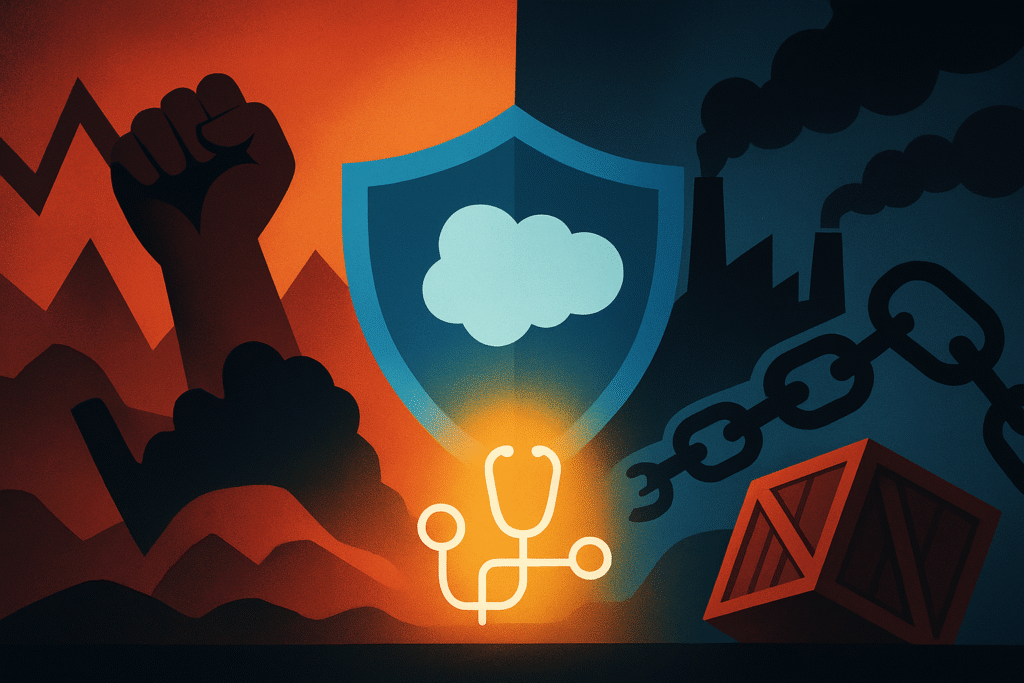
MedTech Under Siege: Innovation from Tariffs, Strikes, and Supply Chain Chaos MedTech Under Siege: How Salesforce Rescues Innovation from Tariffs, Strikes, and Supply Chain Chaos October 10, 2025 11:48 am Himakhi Gogoi Your company has a breakthrough medical device ready to change lives. But there’s a problem. New tariffs just made your components 30% more expensive, your supplier can’t guarantee delivery dates, and your support team is down to half its normal size. This isn’t a nightmare scenario. It’s just another Tuesday in medical technology in 2025. The Perfect Storm Hitting Medical Technology Medical technology companies are fighting battles on three fronts simultaneously. Trade wars have made costs unpredictable, with tariffs changing overnight and forcing difficult choices about pricing or finding new suppliers in unfamiliar markets. Global supply chains remain fragile years after pandemic disruptions, with critical components like specialized semiconductors, rare earth materials, and precision-manufactured parts facing extended delays that can push entire product launches back by months. The workforce crisis adds a deeply human dimension to these operational challenges. Major labor actions, exemplified by the 30,000 Kaiser Permanente workers strike, send shockwaves through the healthcare ecosystem. Beyond these visible strikes, medical technology companies struggle daily to find and retain specialized talent in crucial areas like regulatory affairs, clinical research, and technical support. These aren’t positions you can fill quickly with general hires. They require years of specific experience and deep expertise. These challenges create a devastating cascade effect. Delayed components mean missed product launch deadlines. Understaffed customer service teams can’t maintain support quality, damaging relationships with hospitals and clinics. Regulatory submissions slow down because documentation specialists are splitting time across multiple projects instead of focusing on single initiatives. Innovation slows to a crawl precisely when patients need new medical solutions most urgently. Why Innovation Gets Trapped Here’s the frustrating reality that keeps medical technology executives up at night. The industry has never been better positioned to deliver transformative healthcare solutions. Artificial intelligence is enabling earlier disease detection. Connected devices are making remote patient monitoring truly effective. Precision manufacturing is creating implants and prosthetics that work better than ever before. The devices work brilliantly. The clinical data is strong. Patients desperately need these innovations. But operational chaos keeps breakthrough technologies locked in development limbo while external forces beyond anyone’s control dictate timelines and outcomes. Traditional solutions simply aren’t working anymore. Companies tried hiring more people, but specialized talent isn’t available at any reasonable cost. They tried building larger component inventories, but that ties up massive amounts of capital and doesn’t help when tariffs change the economics overnight. They tried diversifying suppliers, but qualifying new vendors for medical-grade components takes months of rigorous validation work. What the industry needs isn’t just more resources or better contingency plans. It needs fundamentally smarter systems that can absorb shocks, adapt quickly to changing conditions, and keep innovation moving forward even when external circumstances are terrible. How Modern Platforms Enable Resilience The medical technology companies thriving despite these challenges share a common characteristic. They’ve invested in integrated technology platforms that give them visibility, control, and flexibility across their entire operation. These aren’t just software tools for managing customer relationships or tracking inventory in spreadsheets. They’re comprehensive ecosystems that connect every part of the business from research and development through manufacturing, regulatory compliance, sales, and customer support into one intelligent system. Think of it like upgrading from a paper map to a real-time GPS navigation system with live traffic updates. When unexpected obstacles appear, the system doesn’t just tell you there’s a problem somewhere ahead. It immediately shows you alternative routes, estimates the impact on your arrival time, and helps you make informed decisions about how to proceed based on current conditions. That’s the kind of operational intelligence medical technology companies need when tariffs hit without warning, suppliers fail to deliver, or workforce challenges emerge suddenly. Where Salesforce Transforms MedTech Operations Salesforce provides medical technology companies with a comprehensive platform that directly tackles each of these challenges while connecting every part of the business into one intelligent, responsive ecosystem. Life Sciences Cloud serves as your operational command center, providing complete visibility across your entire product lifecycle from initial concept through commercialization and beyond. When tariffs hit critical components, the platform immediately flags affected suppliers and products, calculates the financial impact across your portfolio, and enables rapid scenario planning. Product managers can instantly see which development timelines are at risk and reprioritize resources accordingly. Regulatory teams can assess compliance implications across different markets. Sourcing specialists can identify and evaluate alternative suppliers with built-in workflows that track the entire qualification process. Instead of spending weeks gathering information from disconnected systems and endless spreadsheets, companies can respond to major supply chain shocks in days or even hours. Agentforce directly solves the workforce crisis by augmenting stretched human teams with intelligent AI agents that handle substantial portions of routine work across customer service, sales, and internal operations. When a medical device company loses experienced support staff to attrition or labor disputes, Agentforce agents step in seamlessly to handle common technical inquiries, troubleshooting procedures, and product information requests. They work around the clock across multiple languages and channels, providing consistent coverage that would be impossible with human teams alone, especially during workforce shortages. This frees your remaining specialists to focus exclusively on complex cases that truly require human expertise, judgment, and relationship building. On the sales side, these AI agents qualify leads automatically, schedule product demonstrations with healthcare providers, and guide initial product selection conversations. They learn continuously from every interaction, building an ever-growing knowledge base that captures institutional expertise even as individual employees come and go. For medical technology companies struggling with sales team capacity, this means maintaining consistent, professional outreach and responsiveness to potential customers even with skeleton crews. Health Cloud creates the collaboration infrastructure that keeps dispersed, disrupted teams working together effectively despite physical separation or reduced headcount. When workforce shortages mean fewer people trying to accomplish more work, often from different locations due to remote
