
Picture this: Your fintech company has thousands of customers using your core product, but you’re only capturing a fraction of their potential value. Meanwhile, your competitors are quietly building deeper relationships and higher lifetime values with similar customer bases. The difference? They’ve discovered the hidden profit layer that sits between customer acquisition and churn.
This isn’t speculation. Recent industry analysis suggests there’s approximately $30 billion in unrealized revenue sitting dormant across fintech companies worldwide — money that’s hidden in plain sight within existing customer relationships. The key to unlocking it lies in combining behavioral data with intelligent CRM automation to drive strategic cross-selling and maximize customer lifetime value.
If you’re a decision-maker in fintech, this represents one of the most significant growth opportunities available today. Here’s how smart companies are capitalizing on it.
What Exactly Is This ‘Hidden Profit Layer’?
The hidden profit layer refers to the untapped revenue potential within your existing customer base. Most fintech companies excel at acquiring customers for their primary product — whether that’s a payment processor, lending platform, or investment app. But they often miss the goldmine of additional services these same customers would gladly purchase.
Consider a typical scenario: A small business signs up for your payment processing solution. They’re happy with the service, but you never discover they also need invoice management, expense tracking, or business loans. Meanwhile, they’re purchasing these services from your competitors, often at higher prices than you could offer.
The hidden profit layer emerges when you:
- Identify cross-sell opportunities early in the customer journey
- Understand behavioral patterns that indicate readiness to buy
- Deliver personalized recommendations at the right moment
- Automate follow-up sequences that nurture interest into purchases
Research shows that acquiring a new customer costs 5-25 times more than selling to an existing one. Yet most fintech companies allocate 80% of their resources to acquisition and only 20% to expansion. This imbalance represents massive missed opportunities.
How Behavioral Data Reveals Customer Intent
Your customers are constantly sending signals about their needs, interests, and purchasing intent. The challenge is recognizing and acting on these signals before competitors do.
Behavioral data in fintech context includes:
Transaction Patterns: How often customers use your service, average transaction sizes, seasonal variations, and spending categories can reveal unmet needs. A customer processing high-volume B2B payments might need cash flow management tools.
Product Usage Depth: Customers who fully utilize your core features are prime candidates for complementary services. Someone maximizing your budgeting tools might be ready for investment products.
Support Interactions: The questions customers ask support teams often reveal pain points that additional products could solve. Frequent inquiries about multi-currency support might indicate international expansion needs.
Platform Engagement: Time spent in different app sections, feature adoption rates, and content consumption patterns provide insights into customer priorities and interests.
External Indicators: Credit score changes, business growth signals, or life events (detected through permissioned data sources) can trigger relevant product recommendations.
The magic happens when you analyze these data points collectively rather than in isolation. A customer showing increased transaction volume, exploring advanced features, and asking about integration options is displaying classic expansion signals.
The Role of CRM AI in Unlocking Value
Traditional CRM systems excel at organizing customer information, but they’re reactive by nature. You enter data, create tasks, and hope your team follows up appropriately. CRM AI transforms this dynamic by making your customer relationship management proactive and predictive.
Here’s how AI-powered CRM automation drives results:
Predictive Scoring: AI algorithms analyze behavioral patterns to assign expansion scores to each customer. Instead of guessing who might be interested in additional products, you get data-driven prioritization of your best opportunities.
Automated Trigger Campaigns: When customers exhibit specific behaviors, AI can automatically initiate personalized outreach sequences. A customer who starts processing international payments might receive targeted information about foreign exchange services.
Dynamic Content Personalization: AI customizes email content, app recommendations, and product suggestions based on individual customer profiles and behaviors. This increases relevance and conversion rates significantly.
Optimal Timing Intelligence: AI identifies the best times to approach each customer with cross-sell opportunities, maximizing the likelihood of positive responses while avoiding over-communication.
Conversation Intelligence: AI can analyze support tickets, sales calls, and customer communications to identify sentiment, extract needs, and recommend next best actions for account managers.
The result is a CRM system that doesn’t just store customer information — it actively identifies opportunities and orchestrates the right interactions at the right time.
Real-World Impact: The Numbers Don’t Lie
Companies implementing AI-driven CRM strategies in fintech are seeing remarkable results:
- Cross-sell conversion rates increase by 40-60% when recommendations are based on behavioral triggers rather than broad market segments
- Customer lifetime value grows by an average of 35% within the first year of implementation
- Time to revenue expansion decreases from months to weeks as automated systems identify and nurture opportunities faster than manual processes
- Account manager productivity improves by 50% as AI handles routine identification and initial outreach, allowing humans to focus on high-value relationship building
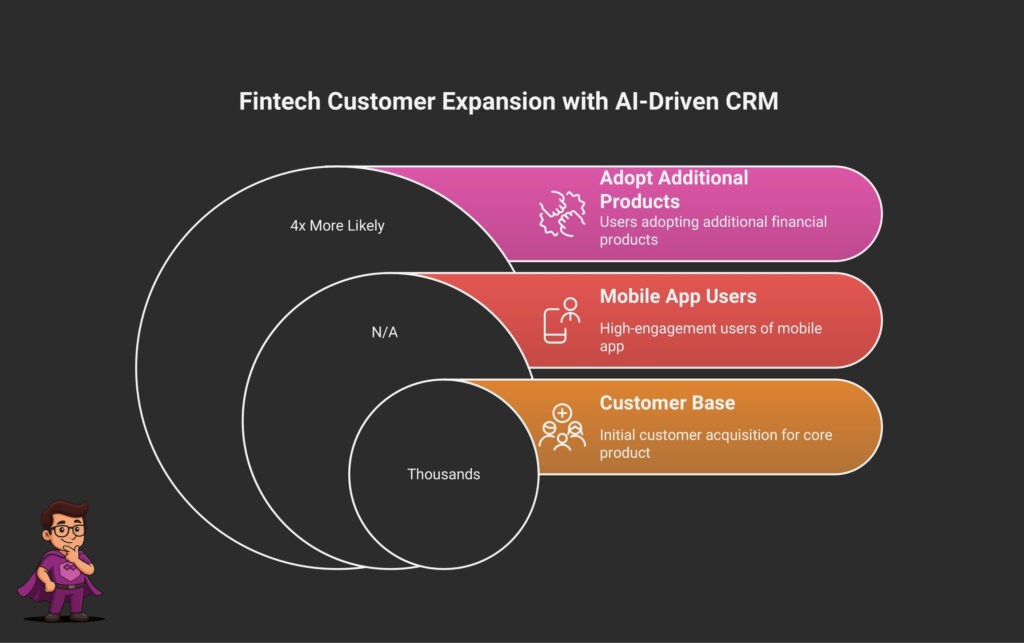
One mid-sized payment processor implemented behavioral AI and discovered that customers who used their mobile app more than 10 times per month were 4x more likely to adopt additional financial products. By automatically triggering personalized campaigns for these high-engagement users, they increased their average revenue per customer by 42% in eight months.
Implementation Strategy: Where to Start
Successfully unlocking your hidden profit layer requires a systematic approach:
Phase 1: Data Foundation Start by auditing your current data collection and ensuring you’re capturing meaningful behavioral signals. This might require updating your tracking infrastructure or integrating new data sources.
Phase 2: AI Integration Choose CRM AI tools that align with your existing tech stack and can process fintech-specific behavioral patterns. Look for solutions that offer pre-built models for financial services rather than generic AI tools.
Phase 3: Process Automation Design automated workflows that trigger based on behavioral data. Start with simple scenarios like “customer increases transaction volume by 50%” and gradually add complexity.
Phase 4: Human-AI Collaboration Train your account management and sales teams to work alongside AI recommendations. The goal is augmenting human expertise, not replacing it.
Phase 5: Continuous Optimization Regularly analyze results and refine your behavioral triggers, messaging, and timing based on actual performance data.
How Salesforce Can Accelerate Your Success
While the concept of behavioral AI and CRM automation applies broadly, Salesforce offers particularly compelling advantages for fintech companies looking to unlock their hidden profit layer.
Financial Services Cloud provides industry-specific data models and workflows designed specifically for fintech operations. This means faster implementation and better out-of-the-box functionality for common scenarios like loan origination, wealth management, and payment processing.
Einstein AI capabilities can analyze your customer behavioral data to identify patterns and predict expansion opportunities with remarkable accuracy. The platform’s machine learning adapts to your specific business model and customer base over time.
Integrated automation tools allow you to create sophisticated trigger campaigns that span email, SMS, in-app notifications, and direct sales outreach — all from a single platform. This ensures consistent messaging and prevents customers from falling through cracks.
Real-time dashboards and analytics give your team immediate visibility into AI-generated opportunities, campaign performance, and revenue attribution. Decision-makers can see exactly how behavioral insights translate into bottom-line results.
Extensive integration ecosystem means Salesforce can connect with your existing fintech infrastructure, payment processors, and third-party data sources to create a comprehensive view of customer behavior.
The combination of industry expertise, proven AI capabilities, and robust integration options makes Salesforce particularly well-suited for fintech companies serious about systematically unlocking their hidden profit potential.
The Bottom Line: Your Next $30 Million Decision
The hidden profit layer in fintech isn’t a future opportunity — it’s money you’re leaving on the table right now. Every day you delay implementing behavioral AI and CRM automation is another day your competitors gain advantage in customer lifetime value and revenue expansion.
The companies that will dominate fintech’s next chapter won’t necessarily be those with the most innovative core products. They’ll be the ones who best understand their customers’ evolving needs and can intelligently deliver additional value at precisely the right moments.
Your existing customer base represents your greatest growth opportunity. The question isn’t whether you can afford to invest in unlocking this hidden profit layer — it’s whether you can afford not to.
Start small, measure results, and scale what works. Your future self will thank you for taking action today.

Why 70%+ CRM Projects Fail…
Why 70%+ CRM Projects Fail — And How Next-Gen Architecture Changes Outcomes January 15, 2026…

Hyper-Personalization as a Competitive Advantage…
Hyper-Personalization as a Competitive Advantage in 2026 January 14, 2026 1:40 pm Adil Gouri Retail…

Salesforce’s Next Frontier: Agentic AI…
Salesforce’s Next Frontier: Agentic AI & Self-Executing Workflows January 14, 2026 11:50 am Darpan Karanje…
