

Healthcare is at a crossroads. Patient expectations are rising, regulatory pressures are mounting, and the workforce is stretched thin. At the same time, technology is advancing faster than ever, promising solutions that seemed like science fiction just a few years ago. For healthcare leaders and decision-makers, the question isn’t whether to embrace digital transformation but how to do it strategically.
As we look toward 2025 and beyond, several key trends are reshaping the healthcare landscape. Understanding these shifts isn’t just about staying current. It’s about positioning your organization to deliver better patient outcomes, streamline operations, and remain competitive in an increasingly tech-driven industry.
The Rise of Hyper-Personalized Patient Experiences
Gone are the days of one-size-fits-all healthcare. Today’s patients expect the same level of personalization they get from their favorite retail brands or streaming services. They want tailored treatment plans, proactive outreach, and communication on their preferred channels, whether that’s text, email, or a patient portal.
This shift is driving healthcare organizations to rethink their entire patient journey. From the first appointment booking to post-treatment follow-ups, every touchpoint needs to feel seamless and personalized. The challenge is that healthcare data often lives in silos across different departments, electronic health records, billing systems, and communication platforms. Breaking down these silos to create a unified patient view is becoming essential, not optional.
Organizations that succeed here aren’t just improving satisfaction scores. They’re seeing real clinical benefits too. Personalized care plans based on comprehensive patient data lead to better adherence, fewer readmissions, and improved health outcomes. The technology to make this happen exists today, but it requires a thoughtful approach to data integration and patient engagement strategies.
Artificial Intelligence Moves from Pilot to Production
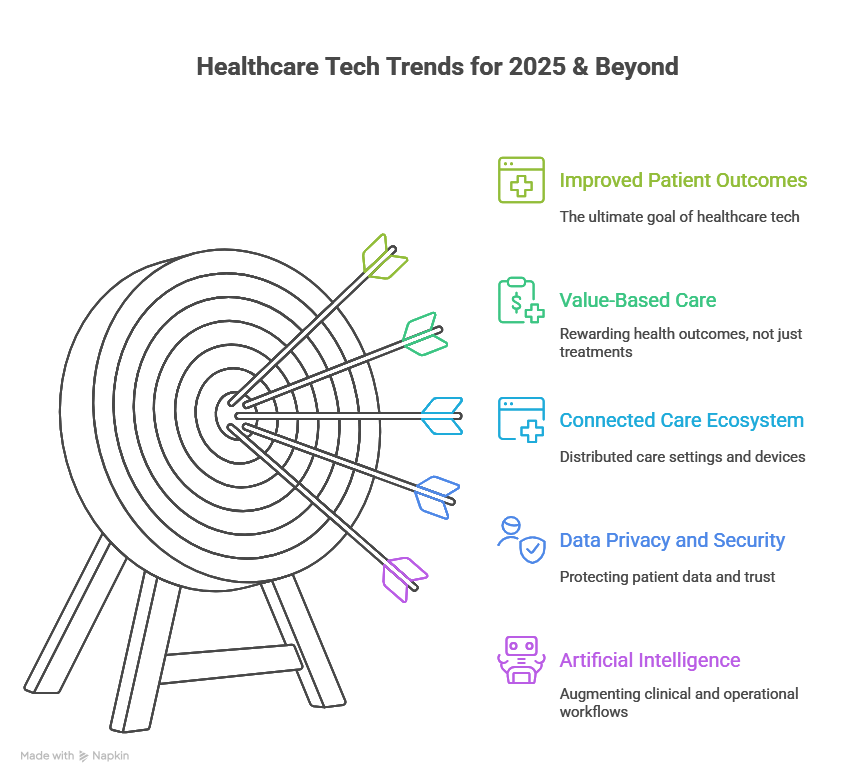
AI in healthcare has moved well beyond the experimental phase. In 2025 and beyond, we’ll see AI embedded into everyday clinical and operational workflows. This isn’t about replacing healthcare professionals but augmenting their capabilities and freeing them from administrative burden.
Clinical AI applications are becoming more sophisticated and reliable. We’re talking about algorithms that can analyze medical images with expert-level accuracy, predict patient deterioration before symptoms appear, and suggest treatment options based on the latest research and similar patient outcomes. The key difference now is that these tools are earning clinician trust and proving their value in real-world settings.
On the operational side, AI is tackling some of healthcare’s most persistent challenges. Scheduling optimization, revenue cycle management, and supply chain logistics are all being transformed by intelligent automation. Healthcare administrators are finding that AI can handle routine inquiries, process claims faster, and even predict staffing needs based on patient volume patterns.
The organizations leading this charge aren’t trying to implement AI everywhere at once. They’re identifying high-impact use cases, starting small, and scaling what works. They’re also being thoughtful about governance, ensuring their AI tools are transparent, fair, and compliant with healthcare regulations.
Data Privacy and Security Take Center Stage
As healthcare becomes more digital and interconnected, protecting patient data has never been more critical. Cyberattacks on healthcare organizations have surged, and the consequences go far beyond financial losses. A data breach can compromise patient safety, erode trust, and result in devastating regulatory penalties.
The regulatory landscape is getting more complex too. Beyond HIPAA, organizations need to navigate state-level privacy laws, international regulations if they operate globally, and evolving standards around data sharing and interoperability. Compliance isn’t just a legal checkbox anymore. It’s a competitive differentiator and a fundamental part of patient trust.
Forward-thinking healthcare organizations are treating security and privacy as core to their digital strategy, not an afterthought. This means investing in robust cybersecurity infrastructure, training staff on data handling best practices, and implementing privacy-by-design principles in every new technology deployment. It also means being transparent with patients about how their data is used and giving them meaningful control over their information.
The Connected Care Ecosystem Expands
Healthcare is becoming less hospital-centric and more distributed. Remote patient monitoring, telehealth, home-based care, and wearable devices are creating a connected care ecosystem that extends far beyond traditional care settings. This trend accelerated during the pandemic and shows no signs of slowing down.
The opportunity here is enormous. Continuous monitoring can catch health issues earlier, reduce emergency room visits, and help patients manage chronic conditions from home. But making this work requires seamless data flow between devices, providers, payers, and patients themselves. It requires platforms that can collect, analyze, and act on data in real-time.
Interoperability is the backbone of connected care. When a patient’s wearable device detects an irregular heartbeat, that information needs to flow quickly to their care team for review. When a patient visits a specialist, that doctor should have instant access to their complete medical history. These scenarios require technology platforms that can integrate diverse data sources and make information accessible to the right people at the right time.
Value-Based Care Demands Better Data and Coordination
The shift from fee-for-service to value-based care models is accelerating. Providers are increasingly being rewarded for keeping patients healthy, not just treating them when they’re sick. This fundamental change requires a completely different approach to data, coordination, and patient engagement.
Value-based care only works when you can track patient outcomes across the entire care journey, identify at-risk populations before they become high-cost cases, and coordinate seamlessly between primary care, specialists, social services, and other stakeholders. The data requirements are substantial, and the coordination challenges are significant.
Organizations thriving in value-based contracts are those that have invested in the infrastructure to support population health management. They can identify gaps in care, reach out proactively to patients who need interventions, and measure outcomes in ways that matter for both clinical quality and financial performance.
How Salesforce Powers Healthcare’s Digital Future
This is where platforms like Salesforce Health Cloud become game-changers for healthcare organizations navigating these trends. Rather than stitching together multiple point solutions, Salesforce provides an integrated platform that addresses the core challenges we’ve discussed.
For personalization, Health Cloud creates that elusive 360-degree patient view by bringing together clinical data, engagement history, and social determinants of health in one place. Care coordinators can see everything they need on a single screen and engage patients through their preferred channels, all powered by a platform designed for relationship management.
On the AI front, Salesforce’s Einstein AI capabilities are purpose-built for healthcare workflows. Predictive analytics can flag patients who might miss appointments or are at risk for readmission. Intelligent routing ensures inquiries go to the right team member. Natural language processing helps automate documentation, giving clinicians time back with patients.
Security and compliance are baked into the platform’s foundation. Salesforce maintains rigorous certifications including HIPAA compliance, provides granular access controls, and offers audit trails that make regulatory reporting straightforward. Healthcare organizations can innovate with confidence, knowing they’re building on a secure, compliant foundation.
For connected care and interoperability, Salesforce integrates with electronic health records, medical devices, and other health IT systems through its robust API framework. This means data from disparate sources can flow into a unified platform where it becomes actionable intelligence, not just scattered information.
Finally, for value-based care, Health Cloud provides the care coordination tools, population health analytics, and outcome tracking capabilities that these programs demand. Care teams can manage patient cohorts, track quality measures, and coordinate across the care continuum, all from a platform they already know how to use.
The Path Forward
Healthcare’s digital transformation isn’t coming. It’s here. The technologies enabling personalized care, AI-powered insights, connected ecosystems, and value-based models are mature and ready for widespread adoption. The question for healthcare leaders is how quickly they can implement these capabilities while maintaining the trust and quality that patients expect.
The organizations that will thrive in 2025 and beyond are those making strategic investments today. They’re breaking down data silos, embracing AI thoughtfully, prioritizing security, building connected care capabilities, and preparing for value-based contracts. Most importantly, they’re choosing platforms that can grow with them and adapt to whatever comes next.
The future of healthcare is digital, connected, and patient-centered. With the right technology foundation and strategic vision, healthcare organizations can turn these trends into tangible improvements in both patient outcomes and operational performance.

Why 70%+ CRM Projects Fail…
Why 70%+ CRM Projects Fail — And How Next-Gen Architecture Changes Outcomes January 15, 2026…

Hyper-Personalization as a Competitive Advantage…
Hyper-Personalization as a Competitive Advantage in 2026 January 14, 2026 1:40 pm Adil Gouri Retail…

Salesforce’s Next Frontier: Agentic AI…
Salesforce’s Next Frontier: Agentic AI & Self-Executing Workflows January 14, 2026 11:50 am Darpan Karanje…
