Your company has a breakthrough medical device ready to change lives. But there’s a problem. New tariffs just made your components 30% more expensive, your supplier can’t guarantee delivery dates, and your support team is down to half its normal size. This isn’t a nightmare scenario. It’s just another Tuesday in medical technology in 2025.
The Perfect Storm Hitting Medical Technology
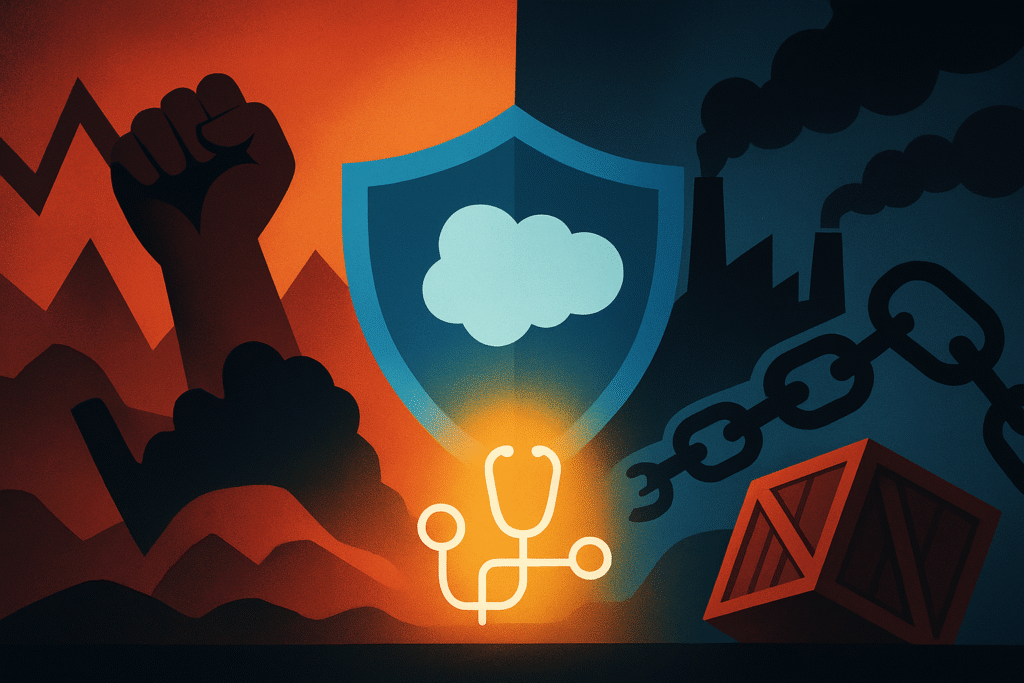
Medical technology companies are fighting battles on three fronts simultaneously. Trade wars have made costs unpredictable, with tariffs changing overnight and forcing difficult choices about pricing or finding new suppliers in unfamiliar markets. Global supply chains remain fragile years after pandemic disruptions, with critical components like specialized semiconductors, rare earth materials, and precision-manufactured parts facing extended delays that can push entire product launches back by months.
The workforce crisis adds a deeply human dimension to these operational challenges. Major labor actions, exemplified by the 30,000 Kaiser Permanente workers strike, send shockwaves through the healthcare ecosystem. Beyond these visible strikes, medical technology companies struggle daily to find and retain specialized talent in crucial areas like regulatory affairs, clinical research, and technical support. These aren’t positions you can fill quickly with general hires. They require years of specific experience and deep expertise.
These challenges create a devastating cascade effect. Delayed components mean missed product launch deadlines. Understaffed customer service teams can’t maintain support quality, damaging relationships with hospitals and clinics. Regulatory submissions slow down because documentation specialists are splitting time across multiple projects instead of focusing on single initiatives. Innovation slows to a crawl precisely when patients need new medical solutions most urgently.
Why Innovation Gets Trapped
Here’s the frustrating reality that keeps medical technology executives up at night. The industry has never been better positioned to deliver transformative healthcare solutions. Artificial intelligence is enabling earlier disease detection. Connected devices are making remote patient monitoring truly effective. Precision manufacturing is creating implants and prosthetics that work better than ever before. The devices work brilliantly. The clinical data is strong. Patients desperately need these innovations. But operational chaos keeps breakthrough technologies locked in development limbo while external forces beyond anyone’s control dictate timelines and outcomes.
Traditional solutions simply aren’t working anymore. Companies tried hiring more people, but specialized talent isn’t available at any reasonable cost. They tried building larger component inventories, but that ties up massive amounts of capital and doesn’t help when tariffs change the economics overnight. They tried diversifying suppliers, but qualifying new vendors for medical-grade components takes months of rigorous validation work. What the industry needs isn’t just more resources or better contingency plans. It needs fundamentally smarter systems that can absorb shocks, adapt quickly to changing conditions, and keep innovation moving forward even when external circumstances are terrible.
How Modern Platforms Enable Resilience
The medical technology companies thriving despite these challenges share a common characteristic. They’ve invested in integrated technology platforms that give them visibility, control, and flexibility across their entire operation. These aren’t just software tools for managing customer relationships or tracking inventory in spreadsheets. They’re comprehensive ecosystems that connect every part of the business from research and development through manufacturing, regulatory compliance, sales, and customer support into one intelligent system.
Think of it like upgrading from a paper map to a real-time GPS navigation system with live traffic updates. When unexpected obstacles appear, the system doesn’t just tell you there’s a problem somewhere ahead. It immediately shows you alternative routes, estimates the impact on your arrival time, and helps you make informed decisions about how to proceed based on current conditions. That’s the kind of operational intelligence medical technology companies need when tariffs hit without warning, suppliers fail to deliver, or workforce challenges emerge suddenly.
 Where Salesforce Transforms MedTech Operations
 Where Salesforce Transforms MedTech Operations
Salesforce provides medical technology companies with a comprehensive platform that directly tackles each of these challenges while connecting every part of the business into one intelligent, responsive ecosystem.
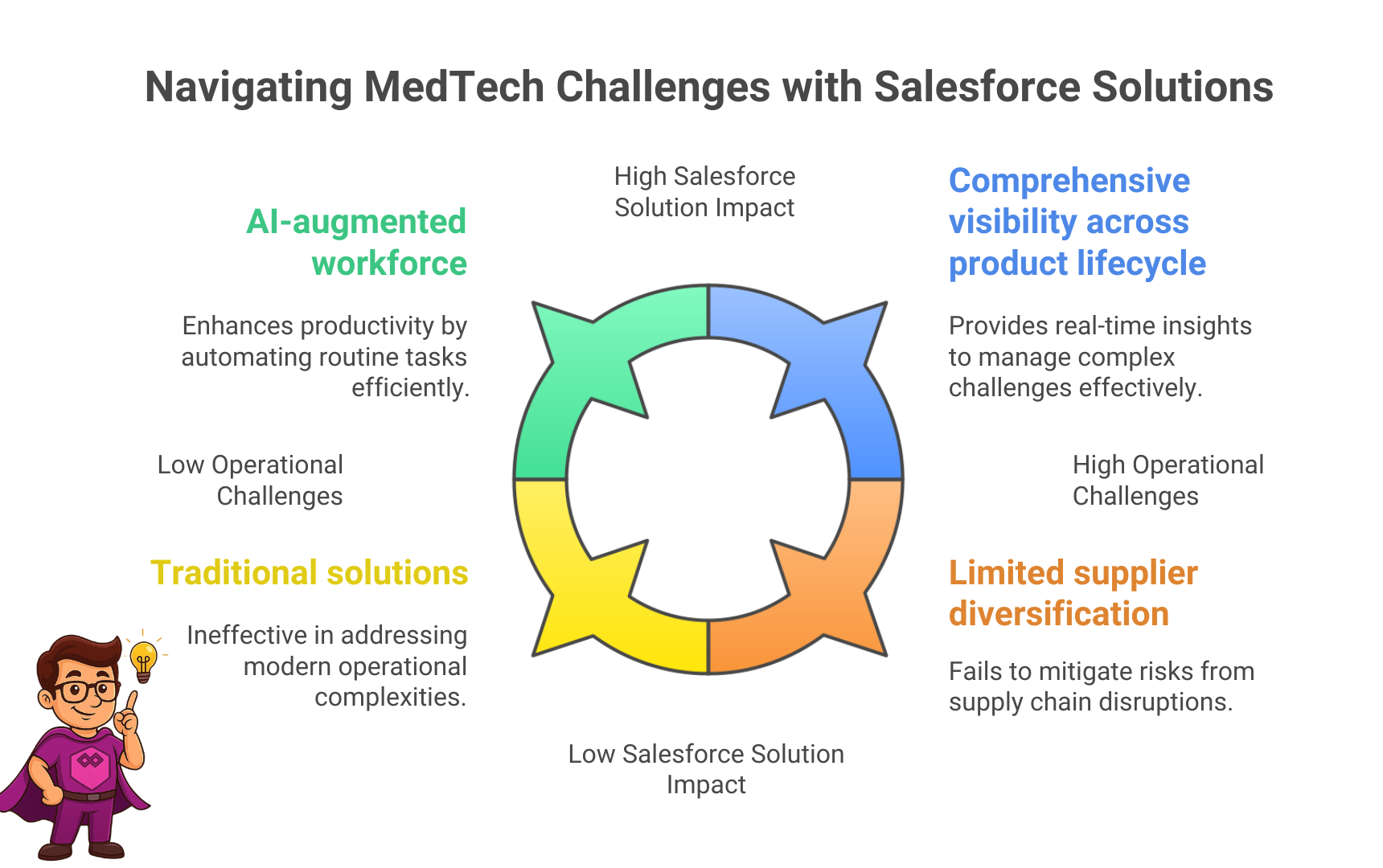
Life Sciences Cloud serves as your operational command center, providing complete visibility across your entire product lifecycle from initial concept through commercialization and beyond. When tariffs hit critical components, the platform immediately flags affected suppliers and products, calculates the financial impact across your portfolio, and enables rapid scenario planning. Product managers can instantly see which development timelines are at risk and reprioritize resources accordingly. Regulatory teams can assess compliance implications across different markets. Sourcing specialists can identify and evaluate alternative suppliers with built-in workflows that track the entire qualification process. Instead of spending weeks gathering information from disconnected systems and endless spreadsheets, companies can respond to major supply chain shocks in days or even hours.
Agentforce directly solves the workforce crisis by augmenting stretched human teams with intelligent AI agents that handle substantial portions of routine work across customer service, sales, and internal operations. When a medical device company loses experienced support staff to attrition or labor disputes, Agentforce agents step in seamlessly to handle common technical inquiries, troubleshooting procedures, and product information requests. They work around the clock across multiple languages and channels, providing consistent coverage that would be impossible with human teams alone, especially during workforce shortages. This frees your remaining specialists to focus exclusively on complex cases that truly require human expertise, judgment, and relationship building.
On the sales side, these AI agents qualify leads automatically, schedule product demonstrations with healthcare providers, and guide initial product selection conversations. They learn continuously from every interaction, building an ever-growing knowledge base that captures institutional expertise even as individual employees come and go. For medical technology companies struggling with sales team capacity, this means maintaining consistent, professional outreach and responsiveness to potential customers even with skeleton crews.
Health Cloud creates the collaboration infrastructure that keeps dispersed, disrupted teams working together effectively despite physical separation or reduced headcount. When workforce shortages mean fewer people trying to accomplish more work, often from different locations due to remote work policies or facility closures, seamless communication and coordination become absolutely critical success factors. Health Cloud provides a unified platform where research teams, clinical operations, manufacturing, regulatory affairs, quality assurance, and commercial teams can all access the same real-time information and collaborate on shared workflows without friction or delays.
Major pharmaceutical and life sciences companies like Bayer have proven this approach works at scale. They maintained innovation momentum even during major global disruptions by keeping teams across dozens of countries connected and coordinated through a single platform, enabling seamless collaboration despite physical distance and operational challenges.
The transformative power emerges when these Salesforce solutions work together in concert. Imagine new tariffs are announced Friday afternoon affecting key components in three of your flagship products. By Monday morning, Life Sciences Cloud has automatically flagged the affected items, calculated the cost impact, and identified which customer commitments might be at risk. Your sourcing team, supported by Agentforce agents who compiled detailed information on alternative suppliers over the weekend, presents viable options in Tuesday’s strategy meeting. Health Cloud ensures your global product development, regulatory, and commercial teams are simultaneously informed, with project managers across multiple continents updating plans in real time. Agentforce handles the inevitable surge of customer inquiries about potential delays while your human representatives focus their attention on strategic accounts requiring personal relationships. What could have been a crisis lasting multiple months becomes a coordinated response completed in three weeks, with minimal disruption to innovation timelines or customer relationships.
Moving Forward in the New Normal
The challenges facing medical technology companies aren’t temporary disruptions that will resolve themselves. Trade tensions, supply chain complexity, and workforce dynamics represent the permanent new reality for the industry. The fundamental question every medical technology company must answer isn’t whether they’ll face these pressures, but whether they have the operational infrastructure in place to not just survive them but actually turn them into competitive advantages.
Success over the next decade won’t come from having the biggest research budget or the most extensive supplier network. It will come from having intelligent, connected operations that can absorb external shocks while staying relentlessly focused on the core mission of getting life-changing medical technologies to patients who need them. Salesforce gives you the visibility to anticipate problems before they become crises, the intelligence to evaluate options and make decisions fast, and the connectivity to coordinate effective responses across global organizations. It multiplies your workforce capacity through AI that handles routine tasks efficiently while your human experts focus on what humans do best: complex problem-solving, relationship building, and innovative thinking. When tariffs threaten product launches, supply chains break down, or teams face impossible workloads, you need systems that turn operational chaos into competitive advantage. For an industry fundamentally dedicated to saving and improving lives, that infrastructure might be the most important technology decision you make.